Polars 2.0 upgrade: the lazy join that now returns rows in a different order
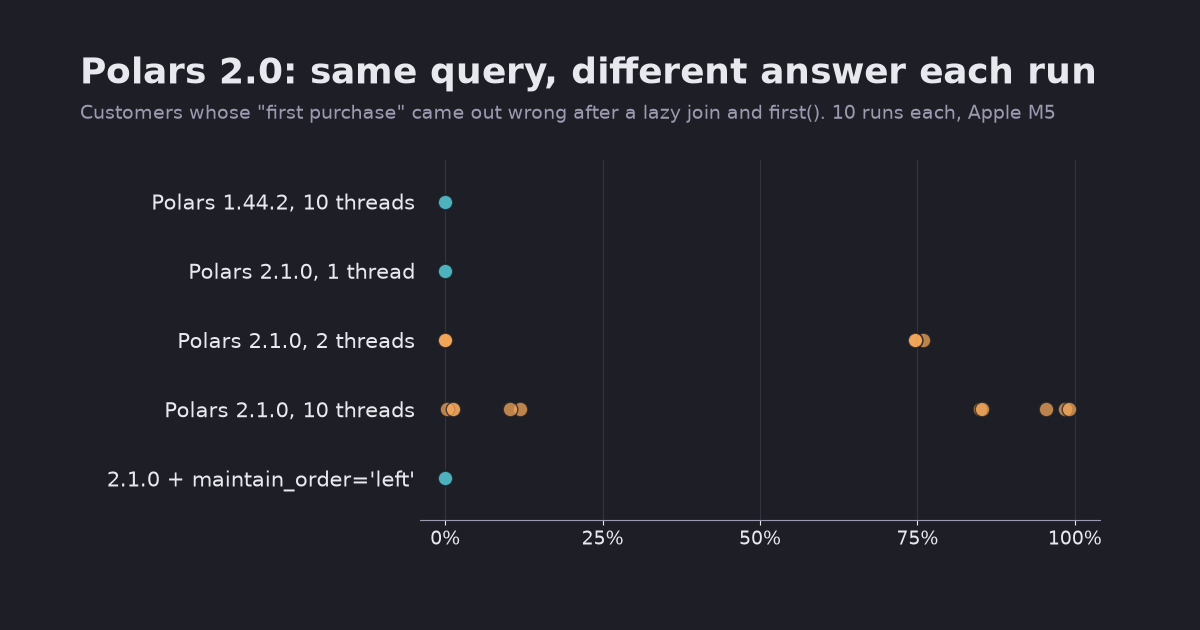
Polars 2.0 runs lazy queries on the streaming engine by default, and joins no longer keep the left row order. A “first purchase per customer” query that was right on 1.44 gave up to 99% wrong rows per run on 2.1. The fixes, plus three other changes that alter results without an error.
Polars 2.0 came out on 2026-10-06, and 2.1 followed on 2026-10-25. The biggest change is in the upgrade guide: LazyFrame.collect() now uses the streaming engine by default. The streaming engine does not promise row order for joins, group-bys or unpivots.
Most breaking changes in 2.0 raise an error, so you find them on the first run. The row order change doesn’t. I ran the same code on Polars 1.44.2 and 2.1.0 to see which changes are silent.
Tested on 2026-10-29 with Polars 1.44.2 and 2.1.0, Python 3.12.13, Apple M5 (10 cores), macOS. All data is generated with NumPy seed 0.
A query that was right on 1.44 and wrong on 2.1
The data is 2 million transactions sorted by time, for 50,000 customers. The query adds the customer table and takes each customer’s first transaction:
import numpy as np
import polars as pl

rng = np.random.default_rng(0)
n = 2_000_000
tx = pl.DataFrame({
    "ts": np.arange(n),  # rows are already in time order
    "customer": rng.integers(0, 50_000, n),
})
customers = pl.DataFrame({"customer": np.arange(50_000), "region": rng.integers(0, 5, 50_000)})

first = (tx.lazy()
         .join(customers.lazy(), on="customer", how="left")
         .group_by("customer")
         .agg(pl.col("ts").first().alias("first_ts"))
         .collect())

truth = tx.group_by("customer").agg(pl.col("ts").min().alias("true_ts"))
check = first.join(truth, on="customer")
print(f"{(check['first_ts'] != check['true_ts']).mean():.1%} of customers got the wrong first purchase")
On Polars 1.44.2 this printed 0.0% every time. On 2.1.0 the join returned the rows in a different order, so first() picked a later transaction. Two runs of this snippet on 2.1.0 printed 100.0% and 98.5%.
The number changes from run to run, so I ran each setup 10 times with first_purchase.py:
| Setup | Wrong “first purchase” (10 runs) | Median time |
|---|---|---|
| Polars 1.44.2, 10 threads | 0% every run | 10 ms |
| Polars 2.1.0, 10 threads | 0.2% to 99.1%, median 48.4% | 9 ms |
| Polars 2.1.0, 2 threads | 0% to 75.9%, median 37.3% | 14 ms |
| Polars 2.1.0, 1 thread | 0% every run | 19 ms |
2.1.0, join(..., maintain_order="left") | 0% every run | 16 ms |
2.1.0, pl.col("ts").min() instead of first() | 0% every run | 8 ms |
2.1.0, collect(engine="in-memory") | 0% every run | 10 ms |
The bug depends on the number of threads. With one thread, the 2.1 result was correct in all 10 runs. A test that runs on a small CI machine can pass, and the same code can give wrong numbers on a larger server.
The 1.x code was already relying on undefined behavior. The 1.44.2 docstring for join says the default maintain_order="none" means “the ordering might differ across Polars versions or even between different runs”. Polars 1.44 just happened to keep the left order in this case.
The group_by was not the problem. Without the join, group_by().agg(pl.col("ts").first()) was correct in every run on 2.1.0 (1, 2 and 10 threads), because Polars keeps the row order inside each group. The join changed the order before the group_by saw it.
How to fix it
Pick the fix by what the code means:
# Best: say what you mean. "First by time" is the minimum time.
.agg(pl.col("ts").min())

# Or keep the order that later steps depend on.
.join(customers.lazy(), on="customer", how="left", maintain_order="left")

# Or sort right before the step that needs order.
.sort("ts").group_by("customer", maintain_order=True).agg(pl.col("ts").first())
min() was also the fastest option here (8 ms). maintain_order="left" made this query slower (16 ms against 9 ms).
To get the old engine back while you audit a codebase, the upgrade guide lists three switches. I checked the environment variable: with POLARS_ENGINE_AFFINITY=in-memory, all five queries in the script gave 0% wrong rows.
pl.Config.set_engine_affinity("in-memory")  # whole process
# or: export POLARS_ENGINE_AFFINITY=in-memory
# or: lf.collect(engine="in-memory")      # one query
Treat this as a temporary step. The 1.x docs already said not to rely on join order, and the switch only hides code that depends on it.
Where to look for this bug: first(), last(), head(), tail(), cum_sum(), shift(), diff() and rank(method="ordinal") after a lazy join, and any code that writes a lazy result to a file and expects the old row order.
Three more changes that don’t raise an error
I ran each one on both versions (probe.py):
| Code | Polars 1.44.2 | Polars 2.1.0 |
|---|---|---|
Int64 column + UInt64 column, value 9,007,199,254,740,993 + 1 | Float64, 9007199254740992.0 | Int128, 9007199254740994 |
df.select(cs.numeric() & pl.col("x")) with numeric columns x=[1,2], y=[3,4] | column x only | columns x and y, values x & x and y & x (bitwise AND): y becomes [1, 0] |
explode("tags") where one row has [] | 3 rows, the empty list becomes null | 2 rows, the row with [] is gone |
The integer change fixes a real precision loss: 1.44 rounded the sum to the nearest float. It still changes the dtype, and code that expects Float64 may break later.
The explode() change can make an ID disappear from your data. If you need the old behavior, the guide says to pass empty_as_null=True.
Changes that do raise an error
These are easy to find, because the first run fails:
| Code | Polars 2.1.0 |
|---|---|
pl.concat([...], how="horizontal") with different heights | ShapeError. Use how="horizontal_extend" to pad with nulls |
int column .is_in([1.0, 2.5]) | InvalidOperationError. Lossy casts are no longer automatic |
df.melt(id_vars="id") | AttributeRemovedError. Use unpivot(index="id") |
The upgrade guide lists many more, including read_csv options, removed APIs and casts that now raise.
What I would do before upgrading
- Search the code for
first(),last(),head()and cumulative functions that run after a lazyjoin,group_byorunpivot. Replace them with explicit sorts ormin()/max(). - Run your tests with
POLARS_MAX_THREADSset to the core count of production. A one-thread run hid the bug here. - Compare a few outputs between 1.x and 2.x on real data, row by row, not only the row count.
For how Polars compares with pandas and DuckDB on speed, see pandas vs Polars vs DuckDB in 2026 (tested on Polars 1.44.2).
The scripts and their raw output: first_purchase.py, first_purchase_out.txt, probe.py, probe_out_1.44.2.txt, probe_out_2.1.0.txt.