Bit tricks in Python, one bit at a time: why ~5 is -6 and how to get 8-bit results
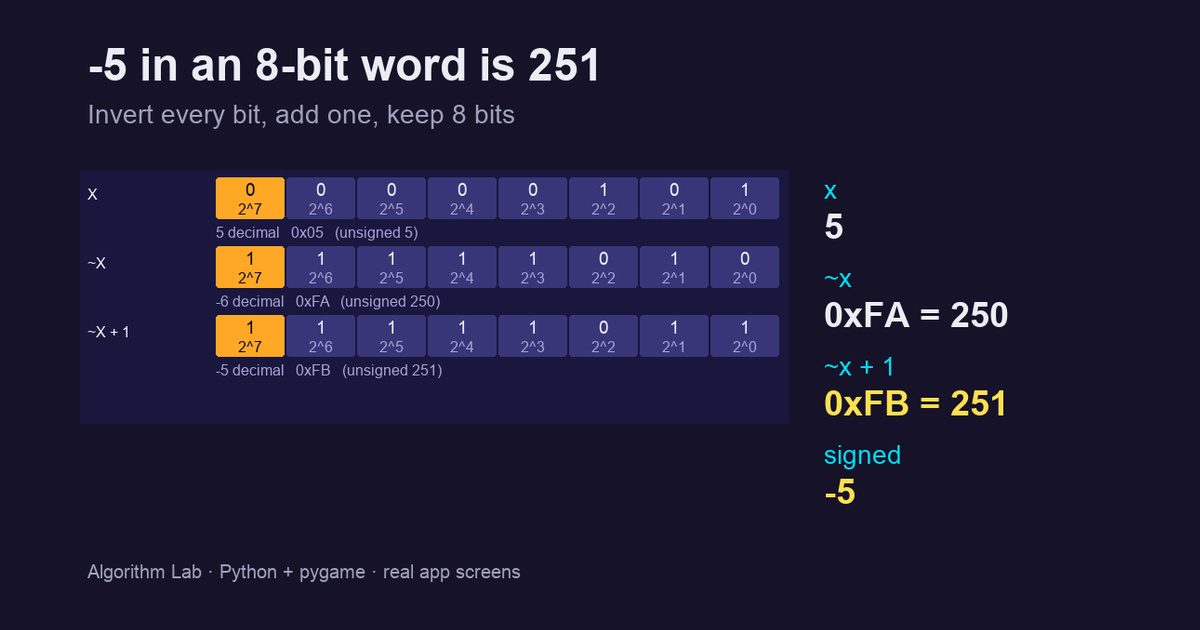
Python integers have no fixed width, so ~5 is -6 and 152 « 2 is 608. An 8-bit visualizer shows what the same operations do inside a fixed word: two’s complement, logical and arithmetic shifts, x & (x - 1), x & -x and the XOR trick, each checked against plain Python.
Try this in Python:
>>> ~5
-6
>>> 152 << 2
608
In C, with an 8-bit unsigned value, you would get 250 and 96. Neither answer is wrong. Python integers have no fixed width: the documentation says bitwise results are computed “as though carried out in two’s complement with an infinite number of sign bits” (Python docs, bitwise operations, checked 2026-10-14). The C-style answers come from cutting the result to 8 bits.
This post uses the bit lessons of the same pygame app as the rest of the series. The app draws each bit of an 8-bit word, so you can see where that cut happens. Every result below was also checked in plain Python.
Tested on 2026-10-14 with Python 3.12.13 and pygame 2.6.1 on macOS. App source: github.com/zayunsna/Algorithm-visualizer.
The one-line fix: mask to the width you mean
To get an 8-bit result, keep only the lowest 8 bits with & 0xFF (in general, & ((1 << W) - 1) for W bits). The app does the same with every result. To read a word as a signed number, check its top bit:
W = 8
MASK = (1 << W) - 1          # 0xFF

def signed(word):            # read an 8-bit word as two's complement
    return word - (1 << W) if word & (1 << (W - 1)) else word

print("~5 =", ~5, "| -5 & 0xFF =", -5 & MASK, "| (~5 + 1) & 0xFF =", (~5 + 1) & MASK)
print("152 as signed 8-bit:", signed(152))
~5 = -6 | -5 & 0xFF = 251 | (~5 + 1) & 0xFF = 251
152 as signed 8-bit: -104
AND, OR and XOR of two non-negative 8-bit values never leave the 8 bits, so they need no mask. With the app’s default inputs, 152 & 60 = 24, 152 | 60 = 188 and 152 ^ 60 = 164, and the app fills the result one column at a time from the truth table:
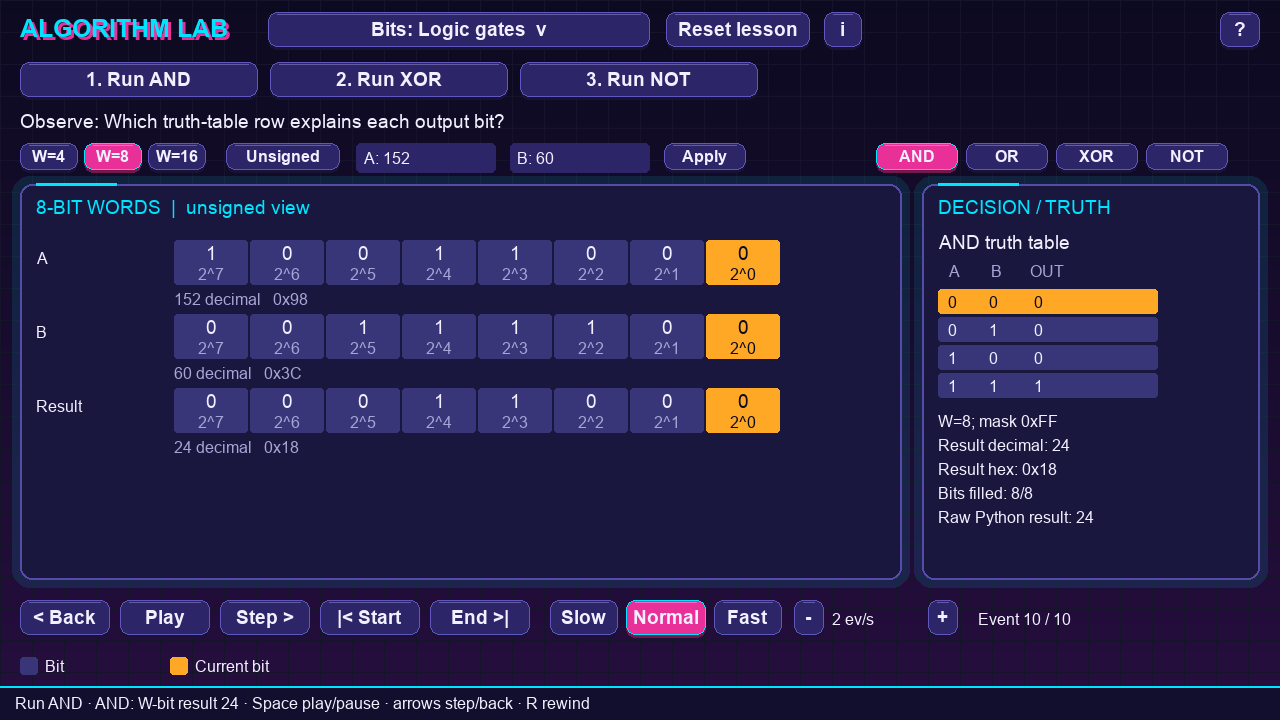
NOT is different: ~152 is -153 in Python and 103 after masking, because NOT also flips the endless leading zeros of a positive Python integer.
Two’s complement: invert and add one
How does an 8-bit word store -5? Invert all bits of 5, then add 1. The carry runs from right to left:
00000101 becomes 11111010 (250), plus one is 11111011: 251 as an unsigned byte, -5 as a signed one. That is the same 251 Python gave for -5 & 0xFF.
The edge case is the most negative value. In 8 bits, -128 is 10000000. Invert it and add one, and you get 10000000 again: +128 does not fit in a signed byte, so negating -128 gives -128.
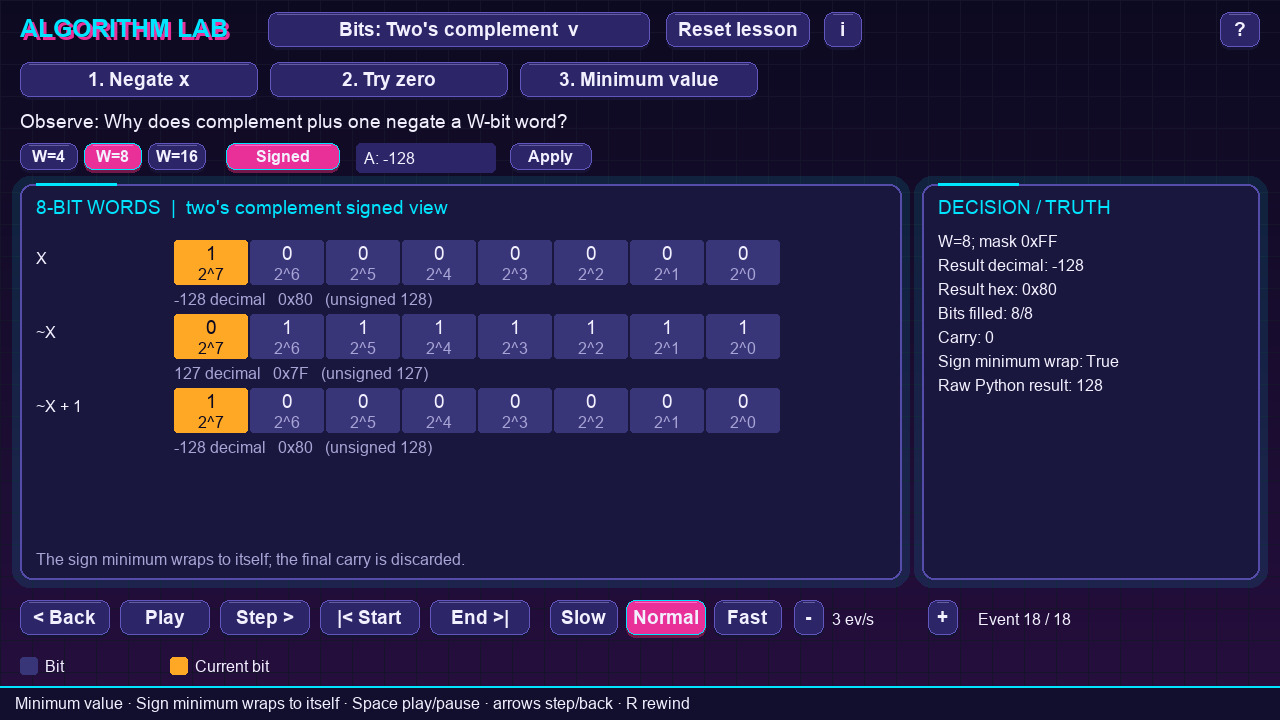
Python never hits this, because its integers just grow. A fixed-width system (C, NumPy int8, a hardware register) does. If you port bit code from C to Python, this is where results start to differ.
Right shift: fill with zeros or with the sign?
Shifting 152 (10011000) right by 2 can mean two things:
- logical shift: fill the new bits with 0 →
00100110= 38 - arithmetic shift: copy the sign bit →
11100110= 230 unsigned, -26 signed
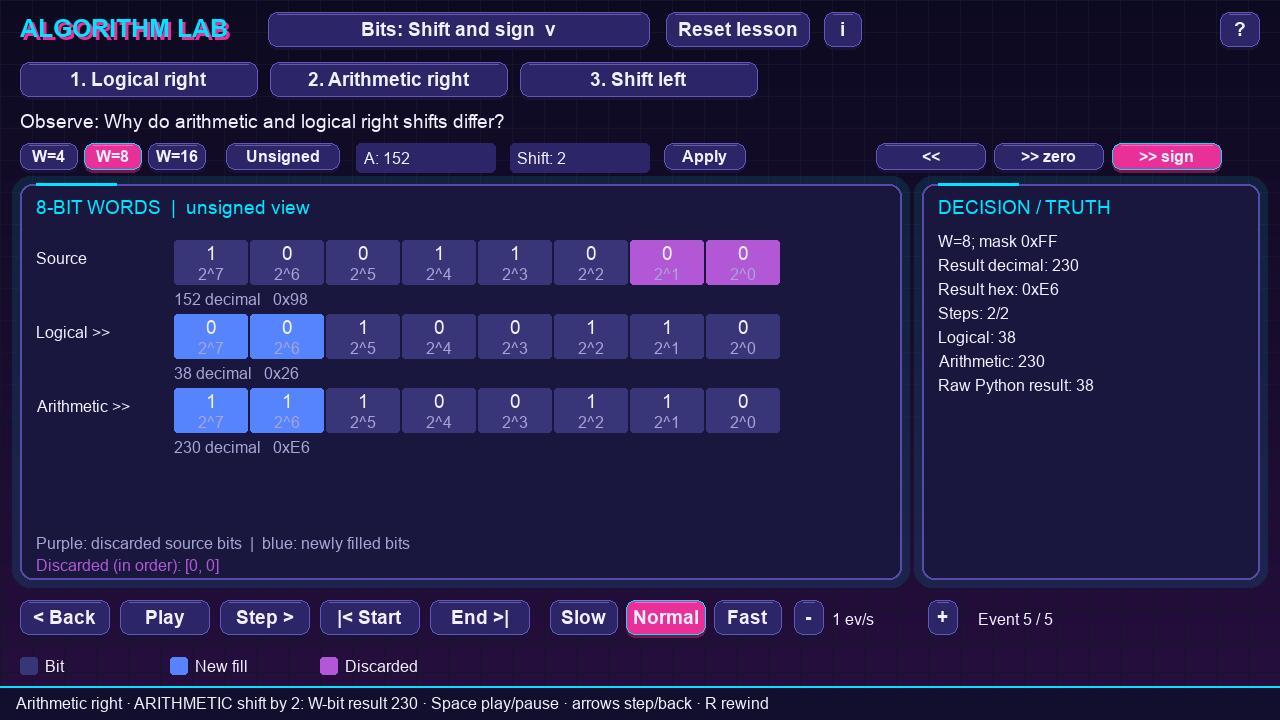
Python’s >> is always arithmetic, but the sign it copies is the sign of the Python integer. 152 is positive in Python, so 152 >> 2 is 38. To get the arithmetic result for the 8-bit word, convert to signed first:
print("logical    152 >> 2:", 152 >> 2)
print("arithmetic 152 >> 2:", (signed(152) >> 2) & MASK, "-> signed", signed(152) >> 2)
print("left       152 << 2:", 152 << 2, "| masked:", (152 << 2) & MASK)
logical    152 >> 2: 38
arithmetic 152 >> 2: 230 -> signed -26
left       152 << 2: 608 | masked: 96
Left shift has the opposite issue: the bits that fall off the top of an 8-bit word stay in a Python integer. Mask after the shift.
Four classic tricks, and why they work
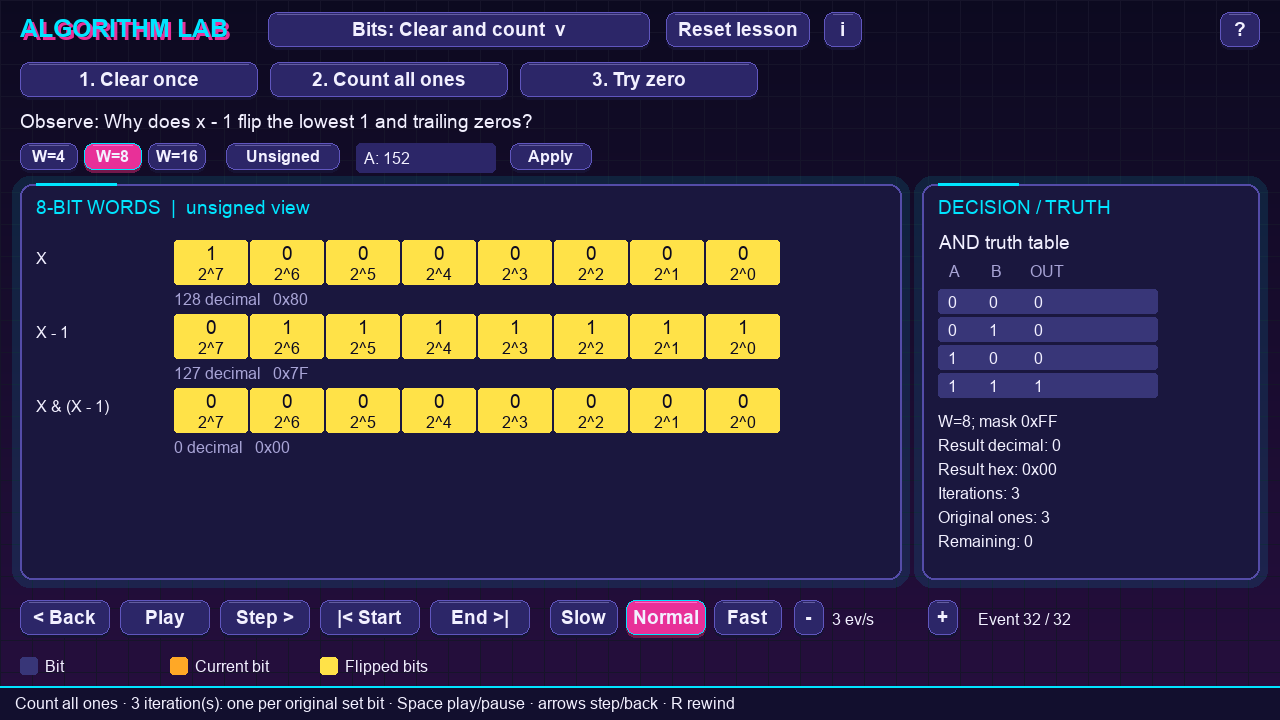
x & (x - 1) clears the lowest 1 bit. Subtracting 1 flips the lowest 1 bit and every 0 to its right. AND with the original keeps everything above and clears that part. 152 = 10011000 becomes 10010000 = 144. Repeat until zero and you have counted the 1 bits (Kernighan’s method): three rounds for 152. Since Python 3.10, int.bit_count() gives that count directly. It counts the bits of the absolute value, so mask a negative number first if you want its two’s complement count.
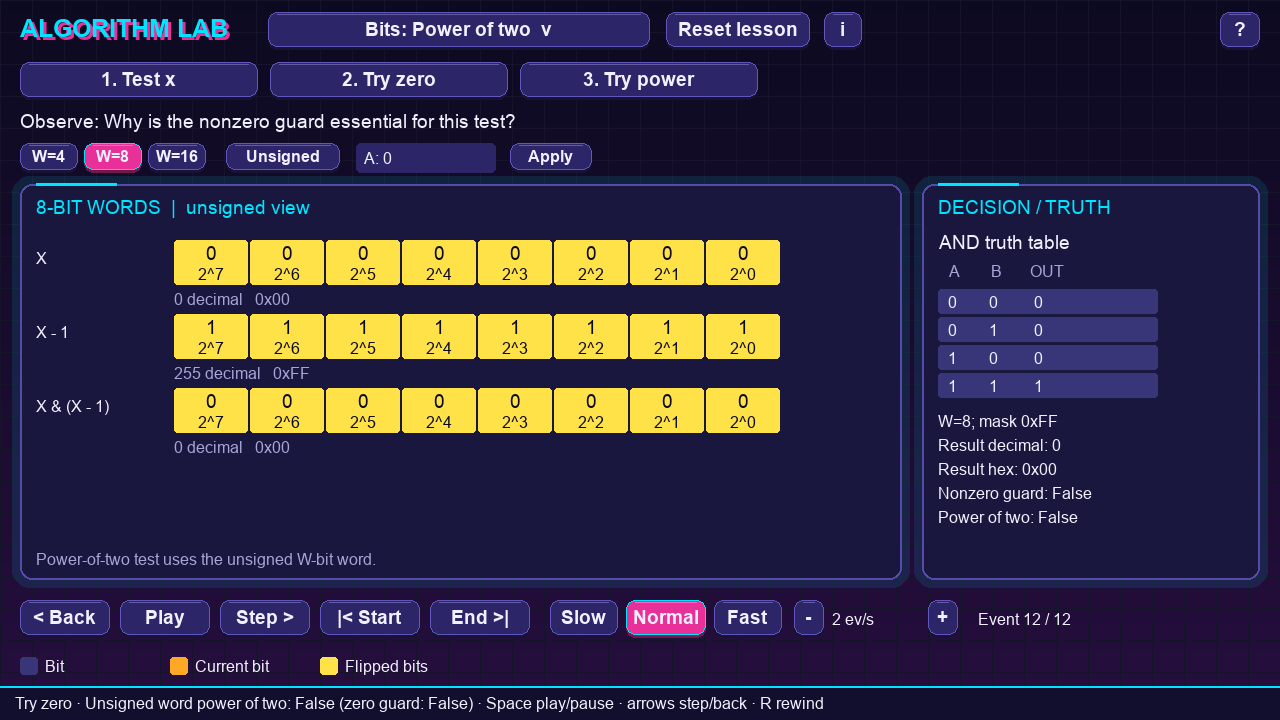
Power of two: x != 0 and x & (x - 1) == 0. A power of two has exactly one 1 bit, so clearing it leaves zero. The x != 0 guard is not decoration: 0 & (0 − 1) is also 0, so without the guard 0 counts as a power of two.
x & -x keeps only the lowest 1 bit. -x is “invert, add one”, which leaves the lowest 1 bit in place and inverts everything above it. AND keeps just that bit: 152 & -152 = 8, and for any odd number the result is 1. This works in Python without a mask.
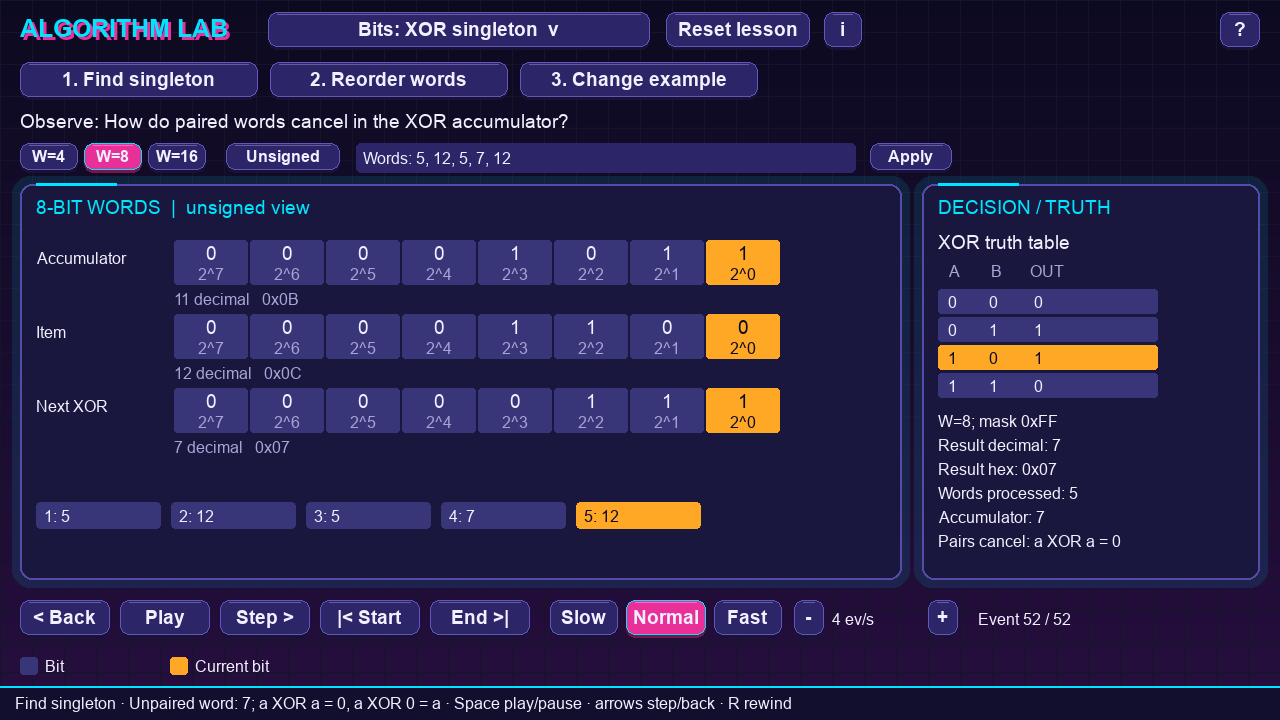
XOR finds the value without a partner. In [5, 12, 5, 7, 12] every number appears twice except 7. Since a ^ a = 0 and a ^ 0 = a, XOR-ing the whole list cancels the pairs, in any order:
The same four checks in plain Python:
n, count = 152, 0
while n:
    n &= n - 1; count += 1
print("ones in 152:", count, "| int.bit_count:", (152).bit_count())
print("lowest set bit, x & -x:", 152 & -152, 37 & -37, 0 & -0)

def is_power_of_two(n):
    return n != 0 and n & (n - 1) == 0
print("power of two:", {n: is_power_of_two(n) for n in (12, 0, 16)}, "| without the guard, 0 gives", 0 & (0 - 1) == 0)

acc = 0
for v in [5, 12, 5, 7, 12]:
    acc ^= v
print("XOR of 5, 12, 5, 7, 12:", acc)
ones in 152: 3 | int.bit_count: 3
lowest set bit, x & -x: 8 1 0
power of two: {12: False, 0: False, 16: True} | without the guard, 0 gives True
XOR of 5, 12, 5, 7, 12: 7
Bitmasks as subsets
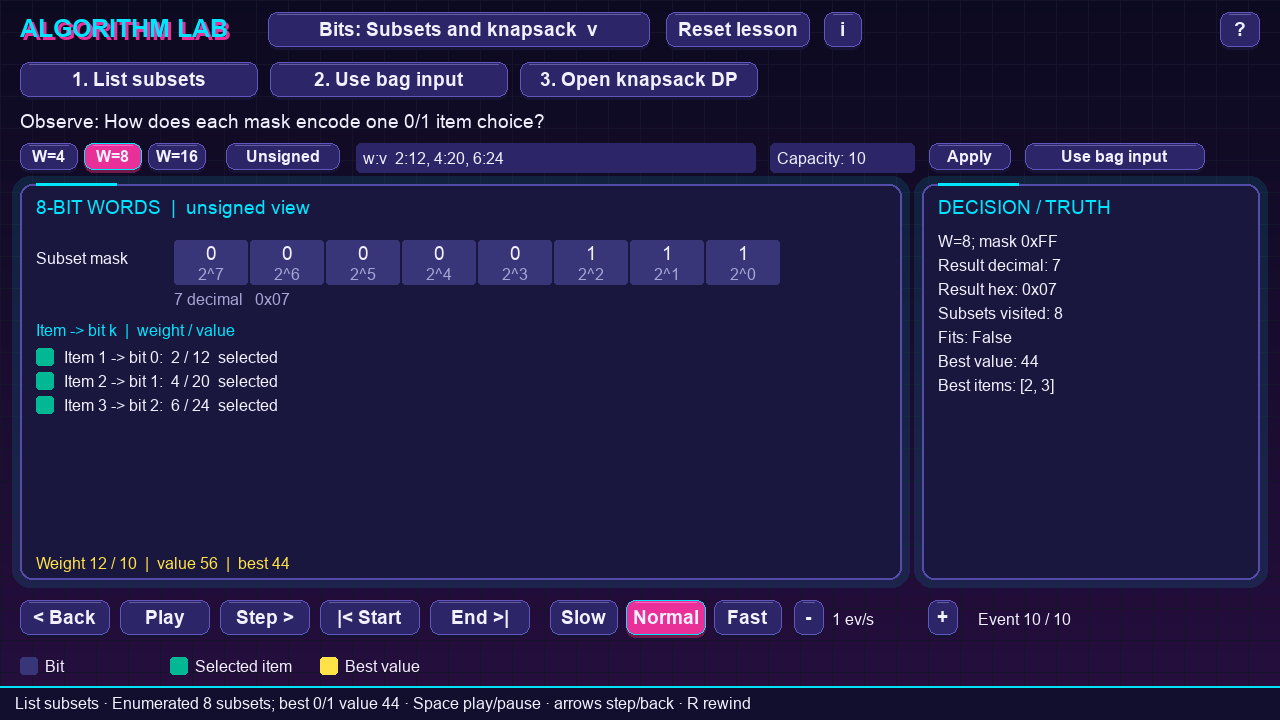
One more use connects back to the knapsack in the DP post. With 3 items, the numbers 0 to 7 in binary (000 to 111) list every possible choice: bit k set means “take item k + 1”. Looping over all masks is a brute-force knapsack:
items, capacity = [(2, 12), (4, 20), (6, 24)], 10
best = (0, 0)
for mask in range(1 << len(items)):
    picked = [i for i in range(len(items)) if mask >> i & 1]
    weight = sum(items[i][0] for i in picked); value = sum(items[i][1] for i in picked)
    if weight <= capacity and value > best[0]:
        best = (value, mask)
print("best subset value:", best[0], "mask:", f"{best[1]:03b}")
best subset value: 44 mask: 110
Mask 110 is items 2 and 3, value 44: the same answer as the DP table, and the one that value-per-weight greedy missed in the greedy post. Brute force is fine for 3 items, but the number of masks doubles with every item, which is why DP exists.
Summary
| You want | Python |
|---|---|
A W-bit result | value & ((1 << W) - 1) |
The signed value of a W-bit word | word - (1 << W) if word >> (W - 1) else word |
Arithmetic right shift of a W-bit word | (signed(word) >> n) & MASK |
| Count 1 bits | x.bit_count() (3.10+), on the masked value for negatives |
| Clear the lowest 1 bit | x & (x - 1) |
| Keep only the lowest 1 bit | x & -x |
| Power of two | x != 0 and x & (x - 1) == 0 |
Try it
git clone https://github.com/zayunsna/Algorithm-visualizer.git
cd Algorithm-visualizer
python3.12 -m venv .venv
.venv/bin/python -m pip install --only-binary=:all: -r requirements.txt
./run.sh
Pick Bits in the lesson menu. You can switch between 4, 8 and 16 bits, toggle signed and unsigned views, and type your own values. Where Python’s own operator gives a different number, the panel shows that raw result next to the masked one.
Related: fp32, fp16, bf16 and int8: what each format stores, and where it breaks