Dynamic programming, step by step: Fibonacci, LCS and 0/1 knapsack in one app
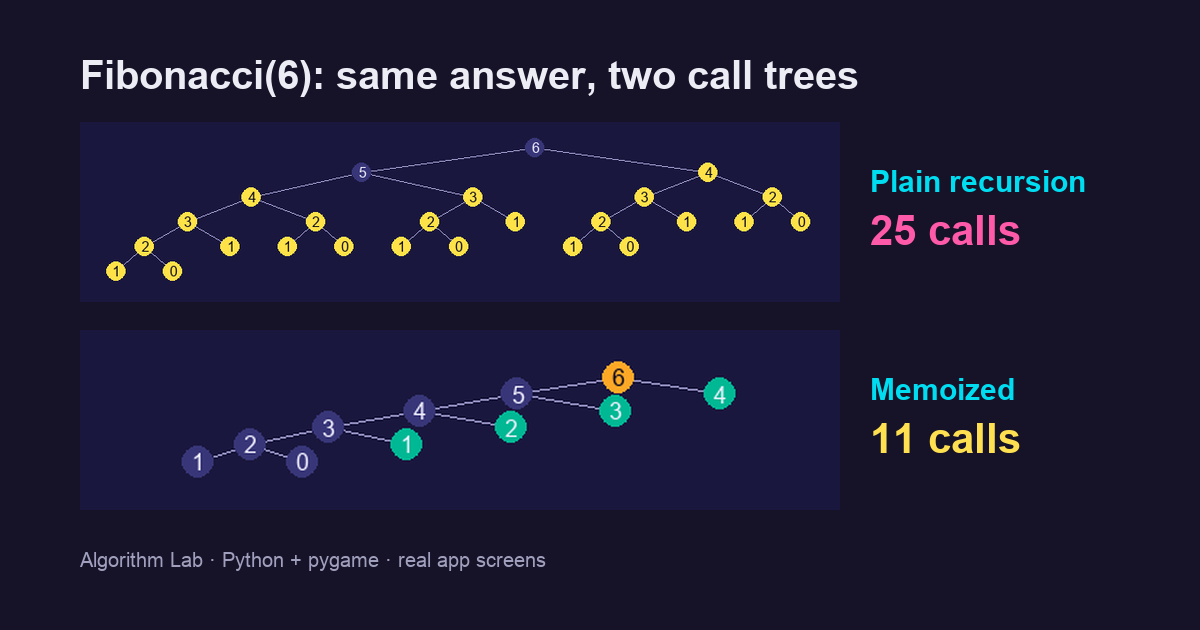
Three classic dynamic programming problems drawn cell by cell in a small pygame app. Memoization cut Fibonacci(8) from 67 calls to 15, the LCS table picked a different answer when the strings were swapped, and the knapsack table found 44 where a value-per-weight greedy got 32.
Dynamic programming (DP) has one idea: when a problem breaks into smaller problems that repeat, solve each one once and reuse the answer. The repetition is easy to say and hard to picture, so this post draws it. The three lessons come from the same pygame app as the path search post, and every number below came out of an actual run:
| Lesson | Input | Result |
|---|---|---|
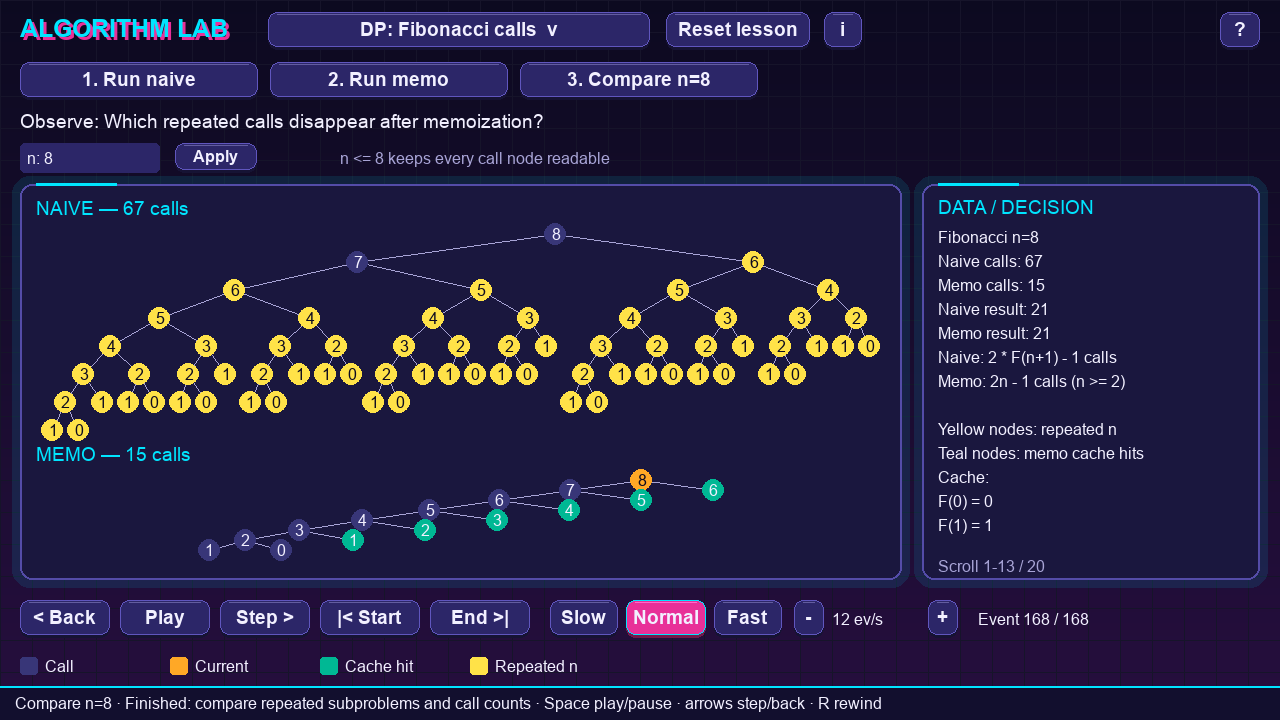
| Fibonacci | n = 6 / n = 8 | plain recursion 25 / 67 calls, memoized 11 / 15 calls |
| Longest common subsequence | ABCBDAB, BDCABA | length 4: BCBA (swap the strings: BDAB) |
| 0/1 knapsack | weights 2, 4, 6; values 12, 20, 24; capacity 10 | best value 44 (items 2 and 3) |
Tested on 2026-10-14 with Python 3.12.13 and pygame 2.6.1 on macOS. App source: github.com/zayunsna/Algorithm-visualizer.
Fibonacci: see the repeated calls, then remove them
F(n) = F(n-1) + F(n-2) is the textbook recursion. Each call makes two more calls, and many of them ask the same question. The app draws every call as a node and colours a node yellow when that n is asked more than once:
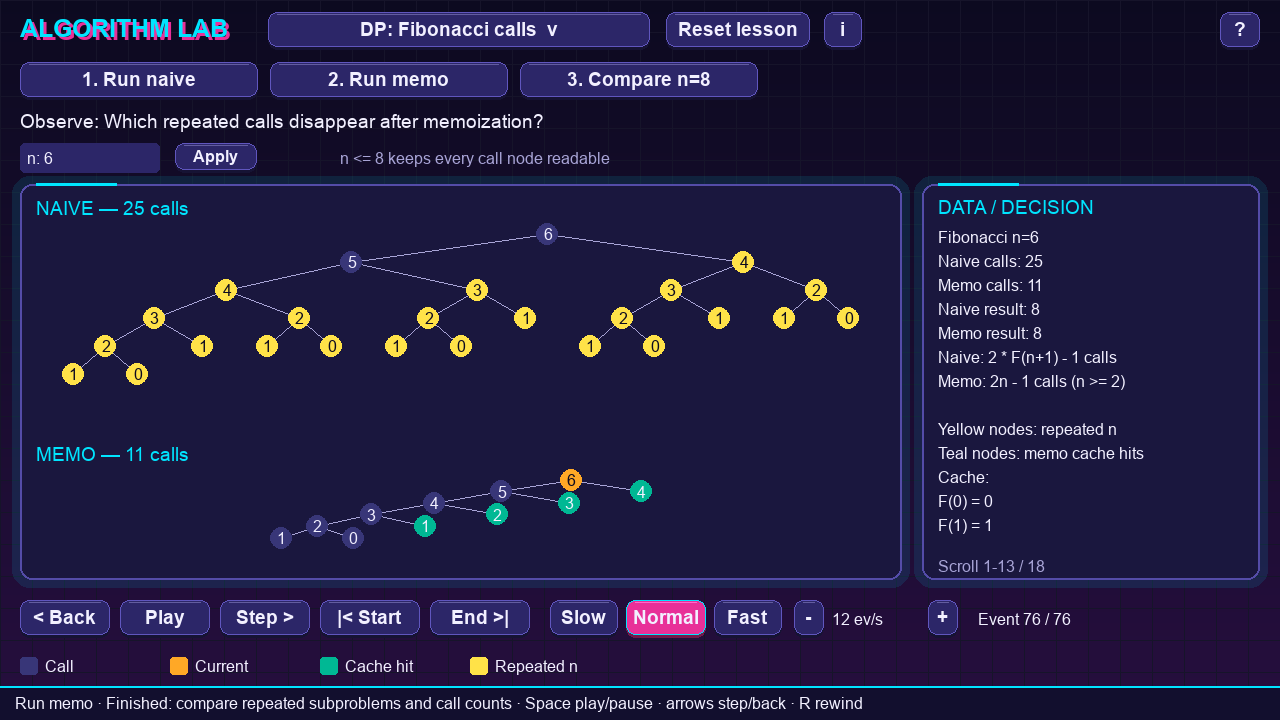
The top tree is plain recursion: 25 calls to get F(6) = 8. F(2) alone is computed five times. The bottom tree is the same function with a cache: 11 calls. Each F(k) is computed once; the teal nodes are calls answered from the cache.
In Python you rarely write that cache yourself. functools.cache does it, and cache_info() counts the calls:
from functools import cache

calls = 0
def fib(n):
    global calls
    calls += 1
    return n if n < 2 else fib(n - 1) + fib(n - 2)

@cache
def fib_memo(n):
    return n if n < 2 else fib_memo(n - 1) + fib_memo(n - 2)

for n in (6, 8):
    calls = 0
    fib_memo.cache_clear()
    value = fib(n)
    fib_memo(n)
    info = fib_memo.cache_info()
    print(f"F({n}) = {value}: plain {calls} calls, memoized {info.hits + info.misses} calls "
          f"({info.misses} computed, {info.hits} cache hits)")
F(6) = 8: plain 25 calls, memoized 11 calls (7 computed, 4 cache hits)
F(8) = 21: plain 67 calls, memoized 15 calls (9 computed, 6 cache hits)
Going from n = 6 to n = 8 nearly triples the plain calls (25 → 67) but adds only four memoized calls (11 → 15). The plain count is 2·F(n+1) − 1, so it grows like the Fibonacci numbers themselves, exponentially. The memoized count is 2n − 1, a straight line. The app stops at n = 8 because a bigger plain tree no longer fits on screen, which is a decent picture of the problem too.
LCS: every cell looks at its neighbours
The longest common subsequence of two strings is the longest sequence of letters that appears in both, in the same order but not necessarily side by side. ABCBDAB and BDCABA share BCBA, for example.
The DP table has one row per letter of the first string and one column per letter of the second. Cell [i][j] holds the LCS length of the first i and first j letters. Each cell follows one rule:
- the two letters match → the cell diagonally up-left, plus 1
- they do not match → the larger of the cell above and the cell to the left
The app highlights the cells the current one depends on. Here the two As match, so the cell takes the diagonal value plus 1:
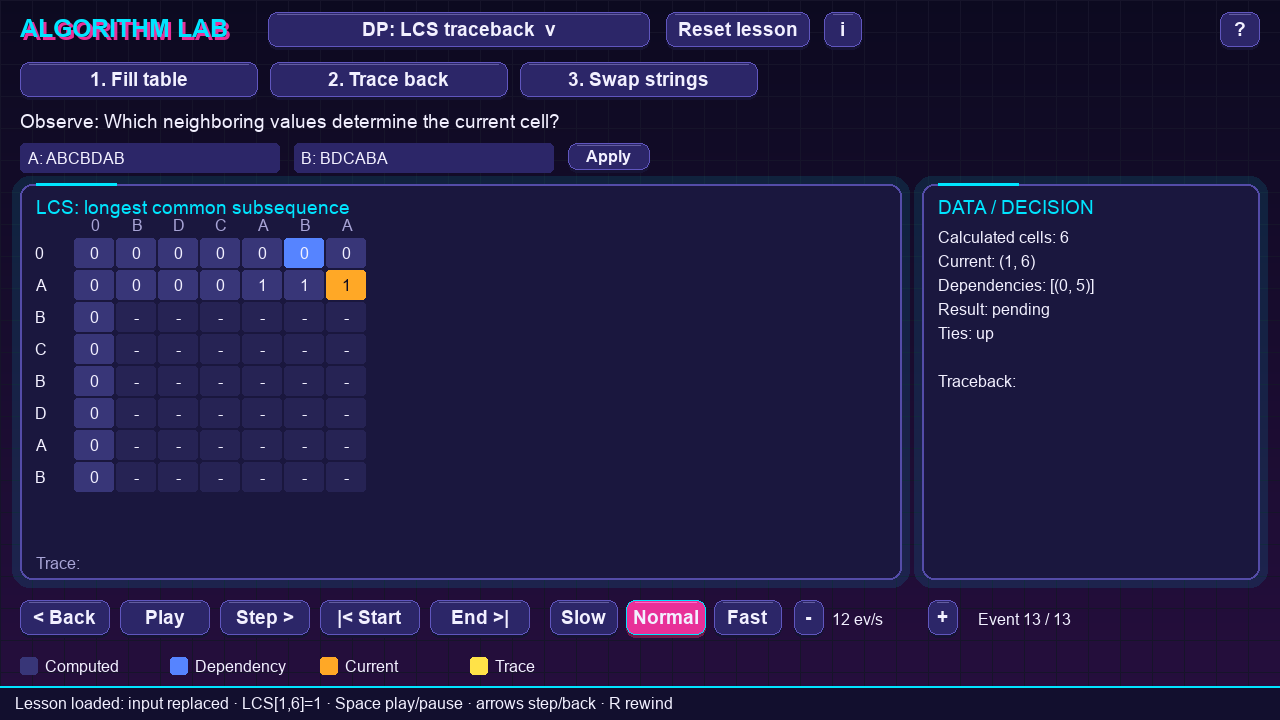
The table only gives the length (4, bottom-right). To get the letters, walk back from the corner: on a match go diagonally and keep the letter, otherwise move toward the larger neighbour. In code:
def lcs(a, b):
    t = [[0] * (len(b) + 1) for _ in range(len(a) + 1)]
    for i in range(1, len(a) + 1):
        for j in range(1, len(b) + 1):
            if a[i - 1] == b[j - 1]:
                t[i][j] = t[i - 1][j - 1] + 1
            else:
                t[i][j] = max(t[i - 1][j], t[i][j - 1])
    i, j, out = len(a), len(b), []          # trace back from the corner
    while i and j:
        if a[i - 1] == b[j - 1]:
            out.append(a[i - 1]); i -= 1; j -= 1
        elif t[i - 1][j] >= t[i][j - 1]:    # tie: go up
            i -= 1
        else:
            j -= 1
    return t[-1][-1], "".join(reversed(out))

print("LCS(ABCBDAB, BDCABA) =", lcs("ABCBDAB", "BDCABA"))
print("LCS(BDCABA, ABCBDAB) =", lcs("BDCABA", "ABCBDAB"))
LCS(ABCBDAB, BDCABA) = (4, 'BCBA')
LCS(BDCABA, ABCBDAB) = (4, 'BDAB')
Look at the >= in the trace back. When the cell above and the cell to the left are equal, one has to be chosen, and this code (like the app) goes up. That choice matters: swap the two strings and the same rule produces a different answer, BDAB, also of length 4.
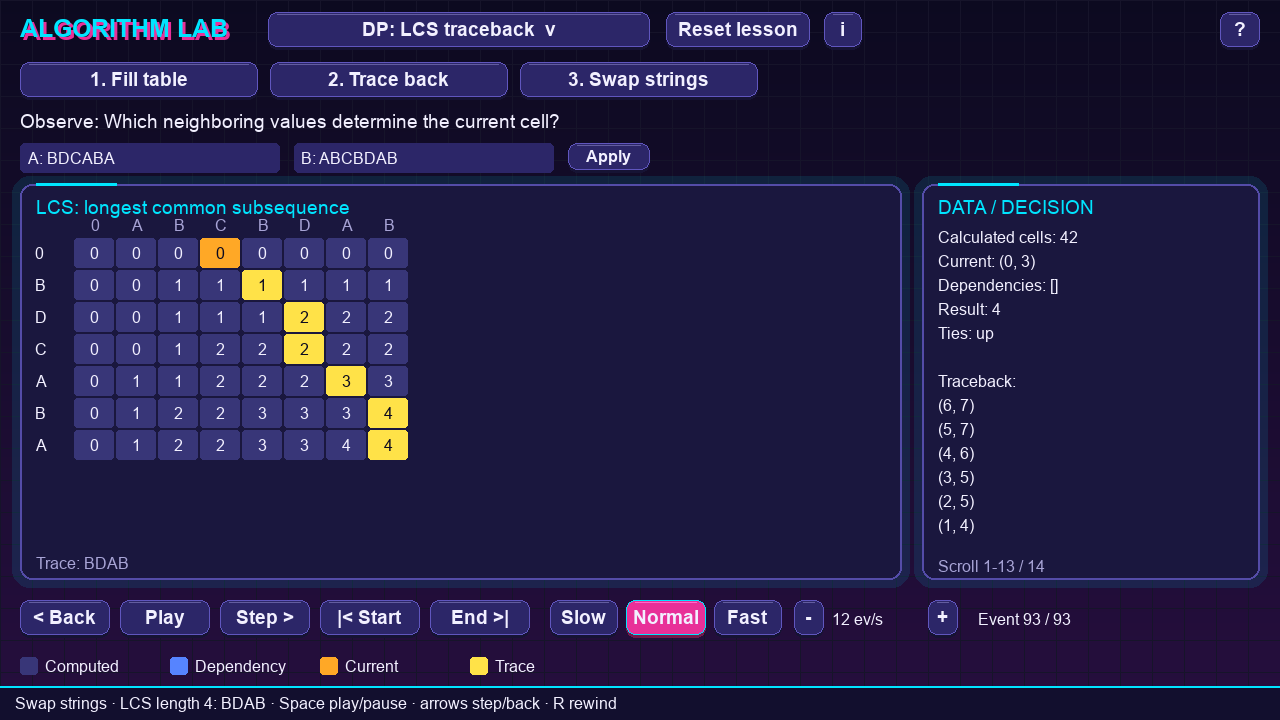
Both are correct. An LCS is a longest common subsequence; there can be several. If your code must give a stable answer, the tie rule is part of the specification.
0/1 knapsack: take it or skip it
Three items, a bag that holds weight 10. Each item can be taken once or not at all:
| Item | Weight | Value |
|---|---|---|
| 1 | 2 | 12 |
| 2 | 4 | 20 |
| 3 | 6 | 24 |
Row i of the table answers “using only the first i items, what is the best value for each capacity 0 to 10?”. For each cell there are two choices:
- skip item
i: the value in the row above, same capacity - take item
i(if it fits): the row above at capacity minus its weight, plus its value
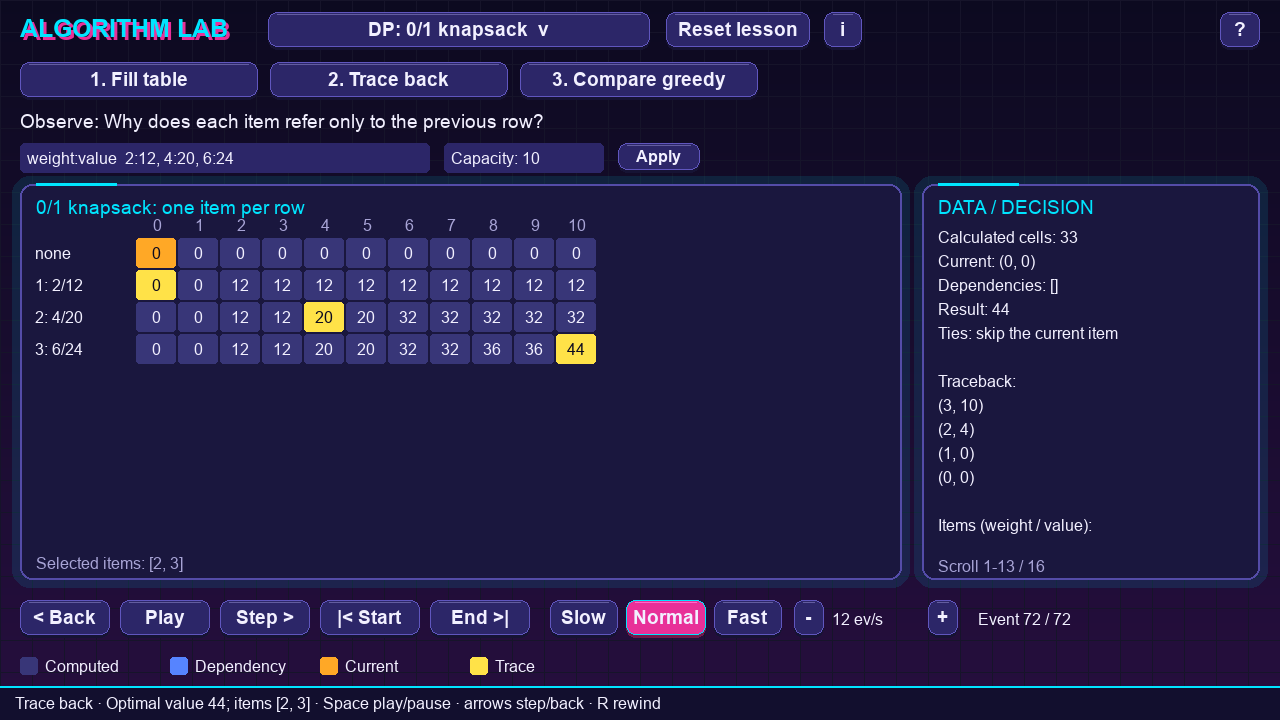
The “take” option looks at the row above, never the current row. That is what makes it 0/1: the row above was built without item i, so item i can only be counted once.
The same table in Python, with the trace back:
def knapsack(items, capacity):
    t = [[0] * (capacity + 1) for _ in range(len(items) + 1)]
    for i, (w, v) in enumerate(items, 1):
        for c in range(capacity + 1):
            t[i][c] = t[i - 1][c]                            # skip item i
            if w <= c:
                t[i][c] = max(t[i][c], t[i - 1][c - w] + v)  # or take it once
    chosen, c = [], capacity                                 # trace back
    for i in range(len(items), 0, -1):
        if t[i][c] != t[i - 1][c]:
            chosen.append(i); c -= items[i - 1][0]
    return t, t[-1][-1], sorted(chosen)

table, best, chosen = knapsack([(2, 12), (4, 20), (6, 24)], 10)
print("knapsack best value:", best, "items:", chosen)
for row in table:
    print(row)
knapsack best value: 44 items: [2, 3]
[0, 0, 0, 0, 0, 0, 0, 0, 0, 0, 0]
[0, 0, 12, 12, 12, 12, 12, 12, 12, 12, 12]
[0, 0, 12, 12, 20, 20, 32, 32, 32, 32, 32]
[0, 0, 12, 12, 20, 20, 32, 32, 36, 36, 44]
The best bag is items 2 and 3: weight 10, value 44. Item 1 has the best value per weight (6 per unit), yet it is not in the answer. Picking by value per weight takes items 1 and 2 and stops at 32, because item 3 no longer fits. The Compare greedy button in the app runs exactly that comparison, and greedy choices are the topic of the next post in this series.
All three snippets printed the same results as the app.
How to tell a problem is a DP problem
Two signs, both visible in the pictures above:
- Repeated subproblems. The yellow nodes in the Fibonacci tree. Without repetition, caching saves nothing.
- The answer is built from smaller answers. Each LCS or knapsack cell needs only two or three cells that were already filled. If you can write that rule, you can fill the table.
The cost is memory: the LCS table has (m+1)(n+1) cells and the knapsack table (items+1)(capacity+1). That is fine at this size; for long strings or large capacities you can keep only the rows you still need, as long as you do not need the trace back.
Try it
git clone https://github.com/zayunsna/Algorithm-visualizer.git
cd Algorithm-visualizer
python3.12 -m venv .venv
.venv/bin/python -m pip install --only-binary=:all: -r requirements.txt
./run.sh
Pick DP in the lesson menu. Each lesson has three numbered steps (for LCS: Fill table, Trace back, Swap strings), and you can type your own strings or items into the input fields. → and ← step one event forward and back.