What is a token, and why do LLMs count tokens instead of words?
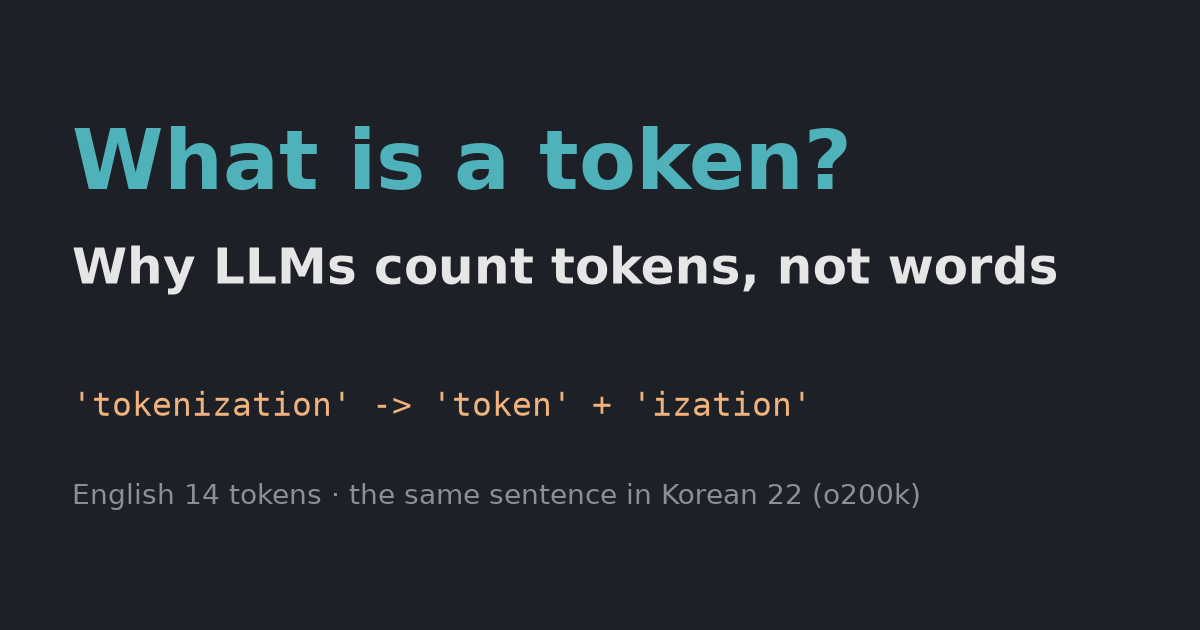
LLMs read text as tokens, not words or characters. We counted tokens for English, Korean, code and numbers across four tokenizers: the same Korean sentence ranged from 22 to 82 tokens.
TL;DR — A token is a chunk of text, often a word piece, that a language model reads as one unit. Prices, context limits and speed are all measured in tokens. The same meaning can cost very different numbers of tokens: in our test, one Korean sentence took 22 tokens with a modern tokenizer and 82 with an older one.
Tested on 2026-09-28 with tiktoken 0.14.0 and the Qwen2.5 tokenizer (transformers 5.17.0). Tokenizers only; no model or API key needed.
Key points
- A tokenizer splits text into tokens from a fixed vocabulary. Common words are one token; rare words are split into pieces.
- Everything is billed and limited in tokens: API prices, the context window, and the maximum output length.
- Non-English text usually needs more tokens for the same meaning. Newer tokenizers narrow the gap a lot.
- Different models use different tokenizers, so the same text has different token counts on different models.
- Count tokens with the model’s own tokenizer before you send long inputs.
How does text get split into tokens?
Here is how the o200k_base tokenizer (used by the GPT-4o, GPT-4.1 and GPT-5 families, according to tiktoken’s model table) splits a few inputs:
import tiktoken

o200k = tiktoken.get_encoding("o200k_base")

def pieces(text):
    return [o200k.decode_single_token_bytes(t).decode("utf-8", errors="replace") for t in o200k.encode(text)]

for text in ["tokenization", " unbelievably", "머신러닝", "1234567.89"]:
    print(f"{text!r:<16} {pieces(text)}")
'tokenization'   ['token', 'ization']
' unbelievably'  [' unbelievably']
'머신러닝'           ['머', '신', '러', '닝']
'1234567.89'     ['123', '456', '7', '.', '89']
- A common word with its leading space (
" unbelievably") can be a single token. - A longer word is split into familiar pieces:
token+ization. - The Korean word for “machine learning” becomes one token per syllable.
- Numbers are split into groups of up to three digits. That is one reason LLMs are unreliable at exact arithmetic.
How many tokens does the same content cost?
We counted tokens for four inputs with four tokenizers, from an older one (r50k_base, GPT-3) to recent ones:
import tiktoken
from transformers import AutoTokenizer

texts = {
    "English":  "Machine learning models learn patterns from data instead of following hand-written rules.",
    "Korean":   "머신러닝 모델은 사람이 직접 쓴 규칙 대신 데이터에서 패턴을 학습한다.",
    "Python":   "df.groupby('category')['amount'].sum().sort_values(ascending=False)",
    "Number":   "The total was 1234567.89 dollars on 2026-09-28.",
}
tokenizers = {
    "r50k (GPT-3)": tiktoken.get_encoding("r50k_base").encode,
    "cl100k":      tiktoken.get_encoding("cl100k_base").encode,
    "o200k":       tiktoken.get_encoding("o200k_base").encode,
    "Qwen2.5":     AutoTokenizer.from_pretrained("Qwen/Qwen2.5-0.5B").encode,
}
print(f"{'text':<8} {'chars':>5} " + " ".join(f"{name:>12}" for name in tokenizers))
for label, text in texts.items():
    counts = [len(enc(text)) for enc in tokenizers.values()]
    print(f"{label:<8} {len(text):>5} " + " ".join(f"{c:>12}" for c in counts))
text     chars r50k (GPT-3)       cl100k        o200k      Qwen2.5
English     89           15           14           14           14
Korean      39           82           40           22           27
Python      67           22           15           15           15
Number      47           17           19           19           28
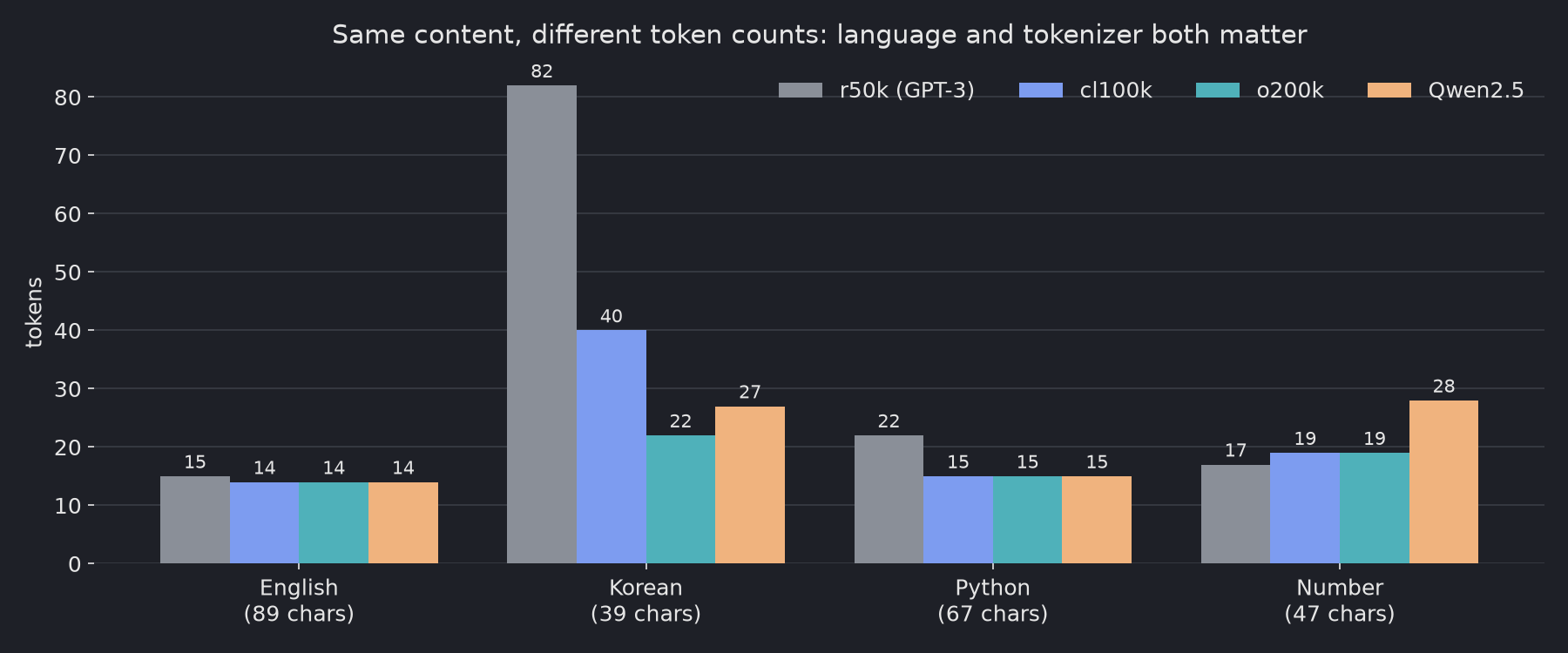
What the numbers say:
- English is cheap everywhere: 14–15 tokens for 89 characters.
- Korean depends heavily on the tokenizer. The older
r50k_basehas almost no Korean in its vocabulary, so it falls back to raw UTF-8 bytes: 82 tokens for 39 characters.o200k_baseneeds 22. - Even with the best tokenizer here, the Korean sentence took 22 tokens against 14 for the same meaning in English, about 1.6× more.
- Qwen2.5 splits numbers into single digits, so the number sentence cost 28 tokens there, against 19 with
o200k_base.
These are single sentences, so treat the ratios as examples, not constants. Measure your own text.
Why does this matter in practice?
| Where tokens show up | What it means for you |
|---|---|
| API pricing | You pay per input and output token. Longer or non-English text costs more |
| Context window | The limit (for example 128k) is in tokens, not words or pages |
| Output limits | max_tokens cuts off the answer by tokens |
| Speed | Models generate one token at a time, so more tokens take longer |
| Odd mistakes | Counting letters or digits is hard when the model sees token + ization, not letters |
How do you count tokens before sending text?
Use the tokenizer that matches the model. For OpenAI models, tiktoken can pick it by model name:
import tiktoken

enc = tiktoken.encoding_for_model("gpt-4o")      # resolves to o200k_base
print(len(enc.encode("How many tokens is this sentence?")))
7
For open models, load the tokenizer from the model’s Hugging Face page with AutoTokenizer.from_pretrained(...), as in the example above.
Sources
- openai/tiktoken — tokenizer library and model-to-encoding table, checked 2026-09-28
- Qwen/Qwen2.5-0.5B — tokenizer used above