How much does quantization hurt an LLM? 8-bit vs 4-bit, tested
We rounded a small model’s weights to 8, 4, 3 and 2 bits and measured perplexity and correct answers. 8-bit changed nothing; 4-bit dropped the 0.5B model from 11 to 4 correct answers, while a 1.5B model kept all 12.
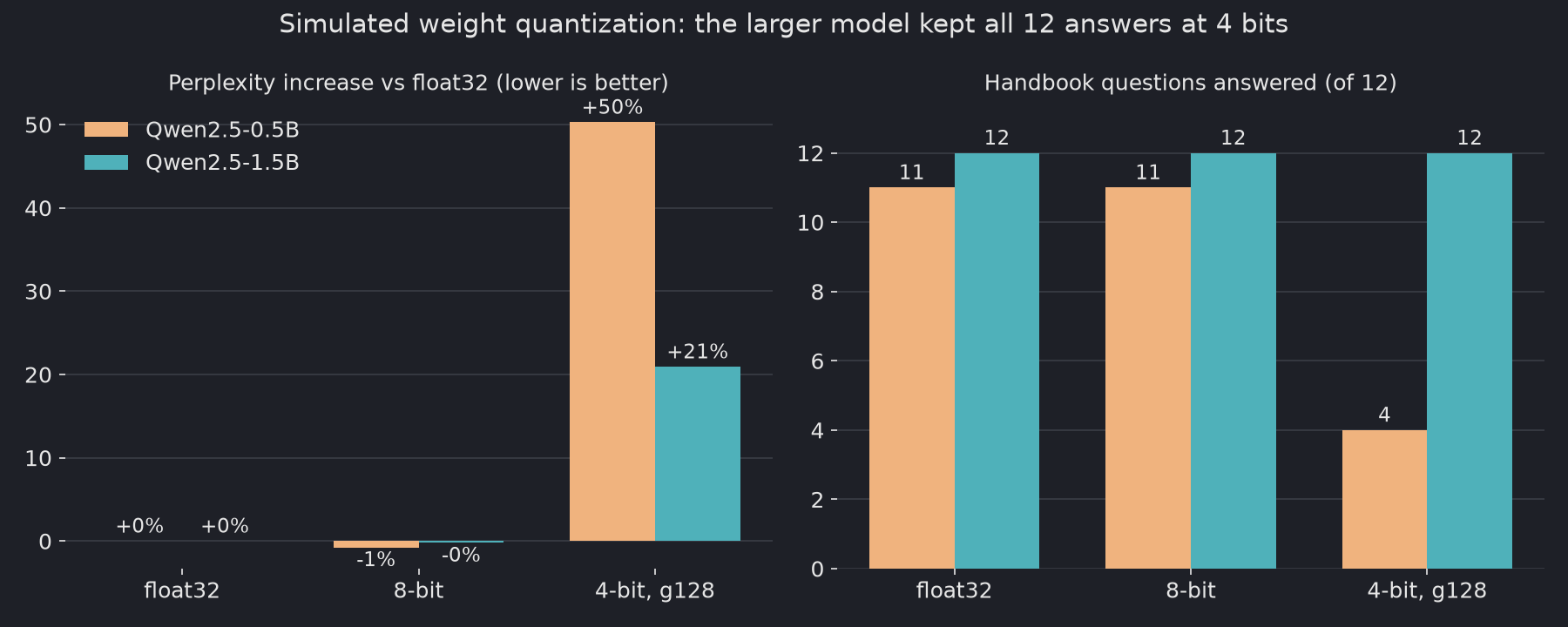
TL;DR — Quantization stores a model’s weights with fewer bits, so the model takes less memory. In our test, 8-bit weights were as good as the original. At 4 bits, a 0.5B model answered only 4 of 12 handbook questions correctly (down from 11), while a 1.5B model still got all 12. Below 4 bits, the small model broke down completely.
Tested on 2026-09-28 with Qwen2.5-0.5B-Instruct and Qwen2.5-1.5B-Instruct (transformers 5.17.0, PyTorch 2.14.0), locally on an Apple M5, no API key. This is simulated weight quantization: weights are rounded to fewer bits and converted back to float, which shows the effect on quality but not on speed or real memory use.
Key points
- Fewer bits per weight, smaller model: float32 uses 32 bits per weight, 8-bit uses 8, 4-bit uses 4.
- 8-bit was lossless here for both models: same answers, perplexity within 1%.
- How you quantize matters. At 4 bits, one scale per row gave 1 correct answer; one scale per group of 128 weights gave 4.
- Bigger models tolerated 4 bits much better: the 1.5B model kept 12 of 12 answers, with perplexity up 21%.
- Test a quantized model on your own tasks before you ship it. Perplexity and task accuracy can tell different stories.
How did we test it?
We rounded every linear layer’s weights to n bits and back (symmetric, round-to-nearest), then measured two things: perplexity on a fixed paragraph (how surprised the model is by the text; lower is better) and the number of correct answers on the 12-question test set from our evaluation post, using its key-fact check.
import copy, math, os, runpy, contextlib, io
import torch
from transformers import AutoModelForCausalLM, AutoTokenizer

name = os.environ.get("MODEL", "Qwen/Qwen2.5-0.5B-Instruct")
tok = AutoTokenizer.from_pretrained(name)
base = AutoModelForCausalLM.from_pretrained(name, dtype=torch.float32).eval()

def fake_quantize(model, bits, group=None):
    """Round every Linear weight to `bits` bits and back to float (symmetric).
    group=None: one scale per output row. group=128: one scale per 128 weights, as most 4-bit formats do."""
    m = copy.deepcopy(model)
    qmax = 2 ** (bits - 1) - 1
    with torch.no_grad():
        for mod in m.modules():
            if isinstance(mod, torch.nn.Linear):
                w = mod.weight
                g = w.reshape(-1, group) if group else w            # rows of `group` weights share one scale
                scale = g.abs().amax(dim=1, keepdim=True).clamp(min=1e-8) / qmax
                mod.weight.copy_((torch.round(g / scale).clamp(-qmax, qmax) * scale).reshape(w.shape))
    return m

# Perplexity on a fixed paragraph (lower = the model predicts the text better)
text = ("Data teams often start a project by collecting historical records, cleaning missing values and "
        "checking how each variable is distributed. Once the data is ready, they split it into training and "
        "test sets, fit a simple baseline, and only then try more complex models. The final step is to monitor "
        "the model in production, because the data it sees tomorrow may differ from the data it was trained on.")
ids = tok(text, return_tensors="pt").input_ids

def perplexity(model):
    with torch.no_grad():
        return math.exp(model(ids, labels=ids).loss.item())

# Answer quality: the 12-question test set and key-fact check from the evaluation post
with contextlib.redirect_stdout(io.StringIO()), contextlib.redirect_stderr(io.StringIO()):
    ev = runpy.run_path("a11_eval.py")
rag, tests = ev["rag"], ev["tests"]
rule = " If the answer is not in the context, say: I don't know."

def key_fact_score(model):
    ask = rag["ask"]
    ask.__globals__["llm"] = model                      # swap the generator; retrieval stays the same
    return sum(key in ask(q, rag["retrieve"](q), rule).lower() for q, _, key in tests)

n_params = sum(mod.weight.numel() for mod in base.modules() if isinstance(mod, torch.nn.Linear))
print(f"Linear weights: {n_params / 1e6:.0f} M parameters")
print(f"{'weights':<13}{'size of Linear weights':>24}{'perplexity':>12}{'key facts (of 12)':>19}")
results = {}
settings = [("float32", 32, None), ("8-bit", 8, None), ("4-bit", 4, None), ("4-bit, g128", 4, 128),
            ("3-bit, g128", 3, 128), ("2-bit, g128", 2, 128)]
if os.environ.get("QUICK"):                             # the larger model: fewer settings to fit in memory and time
    settings = [s for s in settings if s[0] in ("float32", "8-bit", "4-bit, g128")]
for label, bits, group in settings:
    model = base if bits == 32 else fake_quantize(base, bits, group)
    size_mb, ppl, score = n_params * bits / 8 / 1e6, perplexity(model), key_fact_score(model)
    results[label] = (bits, size_mb, ppl, score)
    print(f"{label:<13}{size_mb:>21.0f} MB{ppl:>12.2f}{score:>19}")
Qwen2.5-0.5B-Instruct (default):
Linear weights: 494 M parameters
weights        size of Linear weights  perplexity  key facts (of 12)
float32                       1976 MB       19.87                 11
8-bit                          494 MB       19.72                 11
4-bit                          247 MB       54.31                  1
4-bit, g128                    247 MB       29.86                  4
3-bit, g128                    185 MB      462.82                  0
2-bit, g128                    123 MB 49336006.82                  1
Qwen2.5-1.5B-Instruct (MODEL=Qwen/Qwen2.5-1.5B-Instruct QUICK=1, three settings to fit in 16 GB of memory):
Linear weights: 1544 M parameters
weights        size of Linear weights  perplexity  key facts (of 12)
float32                       6174 MB       14.05                 12
8-bit                         1544 MB       14.02                 12
4-bit, g128                    772 MB       16.99                 12
Both runs gave identical numbers when repeated. The two models share the same tokenizer, which we checked, so the test set is scored the same way.
What do the results show?
| Setting | 0.5B: perplexity | 0.5B: answers | 1.5B: perplexity | 1.5B: answers |
|---|---|---|---|---|
| float32 | 19.87 | 11 / 12 | 14.05 | 12 / 12 |
| 8-bit | 19.72 | 11 / 12 | 14.02 | 12 / 12 |
| 4-bit, one scale per row | 54.31 | 1 / 12 | — | — |
| 4-bit, groups of 128 | 29.86 | 4 / 12 | 16.99 | 12 / 12 |
| 3-bit, groups of 128 | 462.82 | 0 / 12 | — | — |
- 8-bit is safe in this test. The tiny perplexity drop is noise, not an improvement.
- Group size is a big lever. Real 4-bit formats use small groups for exactly this reason.
- The larger model held up at 4 bits. Its perplexity rose 21% against 50% for the small model, and its answers didn’t change.
- Perplexity isn’t the whole story. The 1.5B model’s perplexity went up, but its answers on our task stayed correct.
What does this mean in practice?
| Situation | Suggestion |
|---|---|
| You have enough memory | Run at 16-bit (bfloat16 or float16), the usual default |
| Memory is tight | Try 8-bit first; it cost nothing here |
| You need 4-bit | Use a real method such as GPTQ or AWQ with small groups, rather than plain rounding |
| Choosing between a small model at 16-bit and a bigger one at 4-bit | Test both on your own questions; here the bigger 4-bit model won |
| Any quantized model | Re-run your evaluation set before switching |
Our simulation uses plain rounding, which is the simplest method. GPTQ and AWQ use calibration data to choose better rounding and usually lose less quality at 4 bits. Sizes in the table count only the linear-layer weights and leave out the small overhead for storing the scales.
Sources
- GPTQ: Accurate Post-Training Quantization for Generative Pre-trained Transformers — Frantar et al., 2022
- AWQ: Activation-aware Weight Quantization for LLM Compression and Acceleration — Lin et al., 2023
- Qwen/Qwen2.5-1.5B-Instruct — model card, checked 2026-09-28
Related: How do you evaluate LLM answers? · Prompting vs RAG vs fine-tuning: which one do you need?