Before benchmarking free-threaded Python, check what NumPy already does
On standard Python 3.15, four threads sped up NumPy about 3x but not a Python loop. On the free-threaded build the Python loop scaled about 3x, single-threaded code ran about 14% slower, and NumPy did not change.
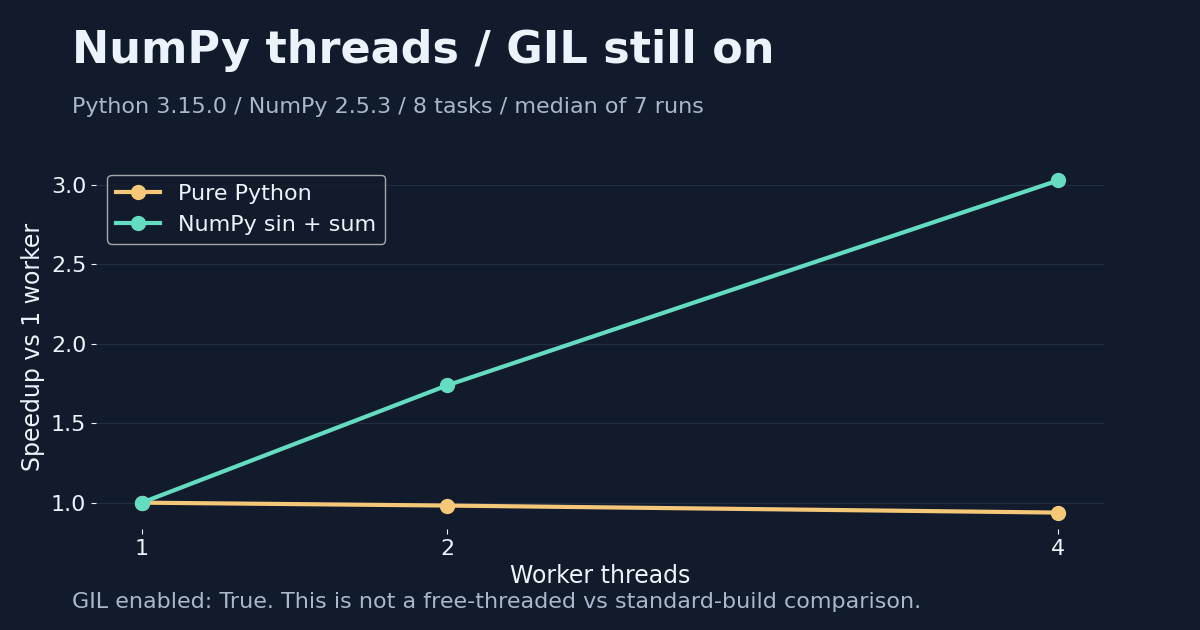
In our ordinary Python 3.15 build, four worker threads reduced a NumPy workload from 25.1 ms to 8.3 ms. The GIL was still enabled. A pure Python workload did not get faster.
That is not evidence for or against free-threaded Python. It shows why “threads ran in parallel” is an insufficient test of whether your interpreter is free-threaded: many numerical operations already release the GIL.
Sources and both builds (standard and free-threaded Python 3.15.0) verified as of 2026-10-12.
Python 3.15.0 was released on October 9, 2026. Free-threading has existed as an optional build since 3.13; installing 3.15 does not itself mean you installed that build. Python’s release page and free-threading guide, checked 2026-10-12.
Check the build and the running process
Run this after importing the packages your real application uses:
import sys
import sysconfig
import numpy as np

print(sys.version.split()[0])
print("NumPy:", np.__version__)
print("free-threaded build:", bool(sysconfig.get_config_var("Py_GIL_DISABLED")))
print("GIL enabled now:", sys._is_gil_enabled())
Our executed output:
3.15.0
NumPy: 2.5.3
free-threaded build: False
GIL enabled now: True
Build support and runtime state are different. An extension that has not declared free-threading support can cause a free-threaded process to enable the GIL. Checking before imports can miss that change. The Python guide describes these mechanisms; do not override compatibility warnings just to get a favorable benchmark.
Compare work, not just thread counts
The executed benchmark runs eight independent tasks with one, two, and four workers. Each task either runs a generator expression in Python or creates its own numeric array and calls sin and sum in NumPy. There are no shared mutable arrays and no matrix multiplication or BLAS workload.
import numpy as np

def python_work(seed):
    return sum((i + seed) % 97 for i in range(1_000_000))

def numpy_work(seed):
    values = np.arange(1_000_000, dtype=np.float64) + seed
    return float(np.sin(values).sum())
The runner creates a thread pool outside the timed repetitions, warms it up, and checks every returned result against the corresponding sequential result. Each configuration has seven measurements. Allocation time remains part of the NumPy task because the task really creates an array.
python -m pip install numpy==2.5.3
python thread_benchmark.py --out threads.json
Tested on 2026-10-12 with Python 3.15.0, NumPy 2.5.3, and macOS 26.6.2 on Apple Silicon. Timing units below are milliseconds; rows summarize the actual run, not a hardware-independent performance promise.
| Workload | Workers | Median | Minimum–maximum |
|---|---|---|---|
| Python generator | 1 | 186.6 | 184.9–196.0 |
| Python generator | 2 | 190.0 | 185.1–196.3 |
| Python generator | 4 | 199.0 | 189.5–205.2 |
| NumPy sin + sum | 1 | 25.1 | 25.0–26.2 |
| NumPy sin + sum | 2 | 14.4 | 13.0–17.4 |
| NumPy sin + sum | 4 | 8.3 | 7.4–9.4 |
NumPy’s documentation explains that many low-level operations release the GIL and recommends independent arrays per worker. It also notes that operations on object arrays do not release it. Our float arrays are not a test of string processing, pandas, or arbitrary Python objects. NumPy thread-safety documentation, checked 2026-10-12.
What changes on the free-threaded build?
We installed the free-threaded build with uv python install 3.15.0t, added the same NumPy 2.5.3 (it installed as a cp315t wheel), and ran the diagnostic above in that interpreter: free-threaded build: True, and GIL enabled now: False even after importing NumPy. Then we ran the same benchmark script on both builds, alternating standard and free-threaded, twice. Medians in milliseconds, first run / second run:
| Workload | Workers | Standard build (GIL on) | Free-threaded build (GIL off) |
|---|---|---|---|
| Python generator | 1 | 184.5 / 182.5 | 209.1 / 209.2 |
| Python generator | 2 | 185.4 / 183.1 | 105.6 / 102.1 |
| Python generator | 4 | 184.5 / 183.6 | 62.5 / 51.7 |
| NumPy sin + sum | 1 | 24.0 / 25.2 | 24.2 / 24.2 |
| NumPy sin + sum | 2 | 12.7 / 13.0 | 12.6 / 12.7 |
| NumPy sin + sum | 4 | 7.4 / 7.5 | 9.9 / 7.4 |
- Pure Python finally scales. With four threads the generator workload took 52–63 ms instead of about 184 ms.
- Single-threaded code paid for it. One worker took 209 ms instead of about 183 ms, roughly 14% slower in this test.
- NumPy did not care. About 24 ms with one worker and 7.4 ms with four on both builds. The 9.9 ms median in the first free-threaded run did not repeat in the second.
Raw results: standard run 1 and run 2, free-threaded run 1 and run 2. This is one machine, one script and two runs per build, not a general verdict. The script does not measure memory, and for matrix operations you would also need to control native-library thread pools, since nested parallelism can dominate the result.
The decision starts with where your time is spent. Pure Python execution and native numeric kernels expose different bottlenecks. Our loop-versus-vectorization experiment covers another part of that distinction. Benchmark your workload before replacing the interpreter, and do not label a GIL-enabled run as a free-threaded result.