model.eval() vs no_grad(): what changes during inference?
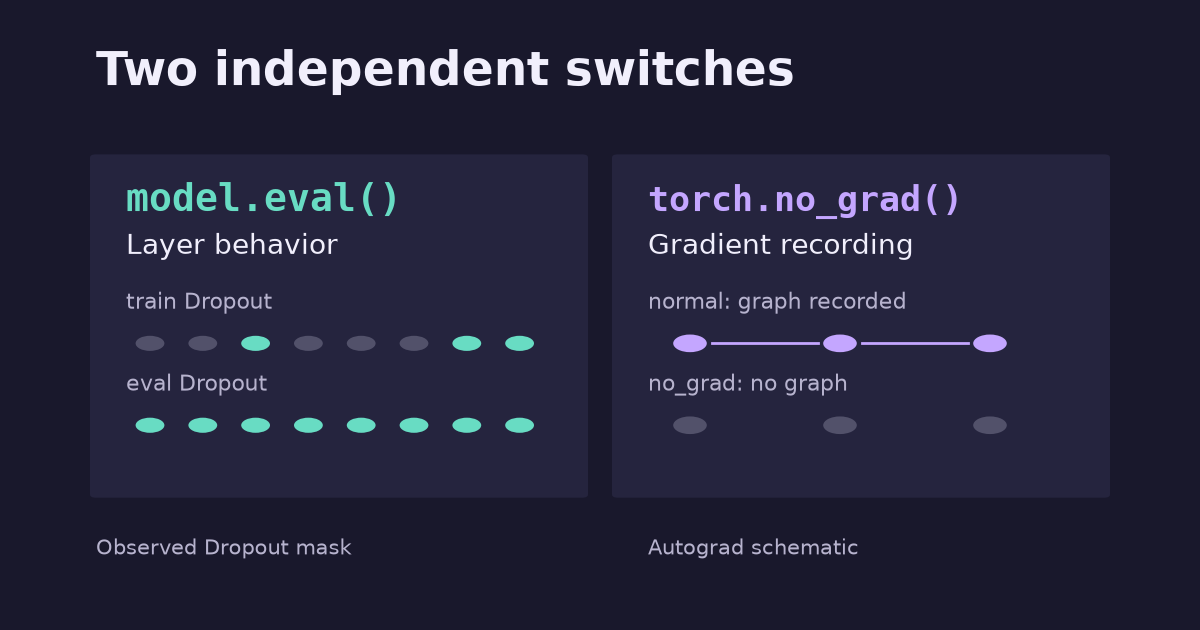
model.eval() changes Dropout and BatchNorm behavior; torch.no_grad() stops reverse-mode gradient recording. Run all four combinations and see why inference usually needs both.
For ordinary prediction, use both:
model.eval()
with torch.no_grad():
    predictions = model(inputs)
eval() selects evaluation behavior in modules such as Dropout and BatchNorm. no_grad() stops recording operations for reverse-mode automatic differentiation inside its context. One does not imply the other.
There are two separate questions: how should this layer behave? and will this computation need a backward pass? PyTorch’s autograd notes explicitly separate the two (checked 2026-10-30).
Run the four combinations
This tiny model has a linear layer with identity weights followed by Dropout. Its parameters require gradients, so normal forward operations can build a backward graph even though the input tensor does not require gradients.
Tested on 2026-10-30 with Python 3.12.13 and PyTorch 2.14.0 on macOS, Apple M5, CPU. No training, GPU or dataset download. Install torch==2.14.0 in a Python 3.12 virtual environment. The complete script, run instructions and recorded output are available.
Run the following as one script. The next Python blocks reuse its imports and variables.
import contextlib
import torch
from torch import nn

model = nn.Sequential(nn.Linear(4, 4, bias=False), nn.Dropout(p=0.5))
with torch.no_grad():
    model[0].weight.copy_(torch.eye(4))
x = torch.arange(1, 9, dtype=torch.float32).reshape(2, 4)

print("mode   no_grad  same_output  output_requires_grad  weight_requires_grad")
for evaluation in (False, True):
    for no_grad in (False, True):
        model.train(not evaluation)  # train(False) is eval()
        torch.manual_seed(0)
        context = torch.no_grad() if no_grad else contextlib.nullcontext()
        with context:
            first, second = model(x), model(x)
        mode = "eval" if evaluation else "train"
        print(f"{mode:<6} {str(no_grad):<8} {str(torch.equal(first, second)):<12} "
              f"{str(first.requires_grad):<21} {model[0].weight.requires_grad}")
Output:
mode   no_grad  same_output  output_requires_grad  weight_requires_grad
train  False    False        True                  True
train  True     False        False                 True
eval   False    True         True                  True
eval   True     True         False                 True
The seed resets once per row, not between the two forward passes. In the two training rows, Dropout samples different masks in this run. no_grad() does not stop that sampling. Two random masks can coincide, especially with tiny inputs, so unequal outputs are an observation here, not a universal test for training mode.
In the evaluation rows, standard nn.Dropout is the identity: it does not drop values. But the third row still has output_requires_grad=True. eval() did not disable the backward graph through the linear layer. The parameters’ requires_grad flag stays True in all four rows.
The Dropout documentation describes its training-time random masking and scaling. Evaluation is not just “use the same random mask every time.” Also, eval() is not a general determinism switch: custom random operations or nondeterministic kernels can still produce different outputs.
no_grad() does not freeze BatchNorm’s state
With default track_running_stats=True, BatchNorm updates running statistics in training mode. That update is a forward-pass state change, not a gradient or optimizer step.
batch = torch.tensor([[10., 20.], [14., 24.]])
for evaluation in (False, True):
    bn = nn.BatchNorm1d(2, momentum=0.1)
    bn.train(not evaluation)
    with torch.no_grad():
        bn(batch)
    means = [round(v, 4) for v in bn.running_mean.tolist()]
    print(f"{'eval' if evaluation else 'train'}: {means}")
Output:
train: [1.2, 2.2]
eval: [0.0, 0.0]
Each row starts with a fresh layer whose running mean is zero. The batch mean is [12, 22], so a training forward with momentum 0.1 updates the buffer to [1.2, 2.2], even inside no_grad(). The evaluation forward leaves it unchanged. These numbers demonstrate the update rule; this fresh, untrained layer is not an example of useful prediction quality.
During evaluation, BatchNorm normally uses the stored statistics rather than the current batch’s. There is an important exception: track_running_stats=False keeps no running estimates and uses batch statistics in evaluation too. eval() cannot turn those nonexistent buffers into learned statistics.
Evaluation can still need gradients
For saliency or sensitivity analysis, you may want evaluation behavior and a backward pass. Continuing with the small linear-plus-Dropout model above:
model.eval()
model.zero_grad(set_to_none=True)
model(x).sum().backward()
print(model[0].weight.grad[0].tolist())
Output:
[6.0, 8.0, 10.0, 12.0]
That is a real gradient through a model in evaluation mode. Wrapping this forward in no_grad() would remove the graph needed by this backward call. Conversely, neither eval() nor no_grad() clears old .grad values or permanently freezes parameters.
For plain validation or prediction, select evaluation mode and use no_grad(); switch back with model.train() before resuming training. Avoid treating “gradients off” as “all model state frozen.” The no_grad reference also documents its scope: it is thread-local, has an exception for tensor factory functions with a requires_grad argument, and does not disable forward-mode automatic differentiation.
The LSTM forecasting tutorial uses evaluation mode plus no_grad() during validation and prediction. Its one-layer LSTM has no inter-layer dropout, so the mode switch alone need not change its output. The distinction matters when you add modules whose training and evaluation behavior differ.