Choose output columns with pandas 3.1 select()
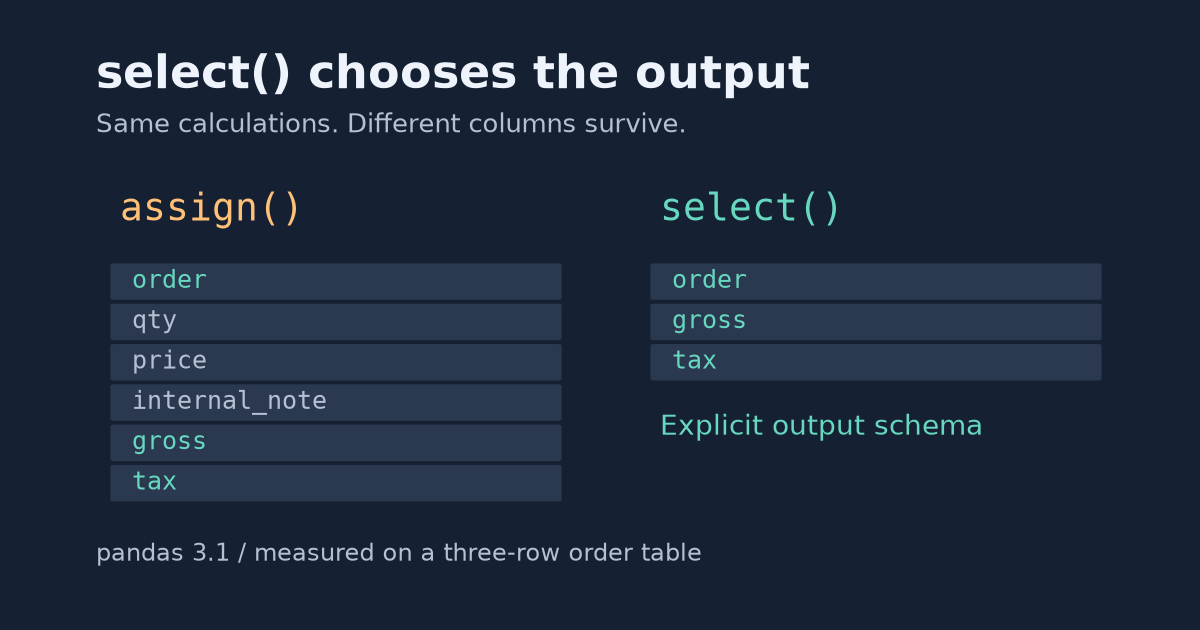
DataFrame.select computes columns while choosing the output schema. Compare it with assign on the same order table, and reproduce the stale-Series mistake that gives different totals inside one call.
Use select() when you want to calculate columns and choose which columns leave the step. Use assign() when you want to add or replace columns while keeping the rest of the table.
On the same three-row order table, both methods calculated identical gross amounts and tax. select() returned three named output columns. assign() returned six, including an internal note that the output did not need. Both methods produced the same values for the three selected columns.
pandas 3.1.0, released October 22, 2026, adds DataFrame.select. The examples here were executed on 2026-10-30, Python 3.12.13 and pandas 3.1.0 on macOS. API and release details as of 2026-10-30. The input is a constructed order table. Full executable script, output and run instructions are included.
Define the output schema
Install pandas==3.1.0 in a Python 3.12 virtual environment, then run these Python blocks in order.
import pandas as pd

orders = pd.DataFrame(
    {'order': ['A', 'B', 'C'], 'qty': [2, 3, 1],
     'price': [10., 20., 30.], 'internal_note': ['x', 'y', 'z']},
    index=[10, 20, 40],
)
selected = orders.select(
    'order',
    gross=pd.col('qty') * pd.col('price'),
    tax=pd.col('gross') * 0.1,
)
print(selected.to_string())
   order  gross  tax
10     A   20.0  2.0
20     B   60.0  6.0
40     C   30.0  3.0
The positional string keeps order. The keyword arguments name computed columns. tax can use gross, which was computed earlier in the call. Input columns such as qty and price are available to expressions without being included in the final output. The non-default row index survives.
Compare that with assign():
assigned = orders.assign(
    gross=pd.col('qty') * pd.col('price'),
    tax=pd.col('gross') * 0.1,
)
print(selected.columns.tolist())
print(assigned.columns.tolist())
pd.testing.assert_frame_equal(selected, assigned[['order', 'gross', 'tax']])
print(orders.columns.tolist())
['order', 'gross', 'tax']
['order', 'qty', 'price', 'internal_note', 'gross', 'tax']
['order', 'qty', 'price', 'internal_note']
The assertion verifies the same values, index, column order and dtypes after projecting the assigned result. Both calls leave orders unchanged. select() combines the calculations and projection into one call, while assign() retains the other input columns.
At an export boundary, the explicit list can also keep unrelated columns from drifting into the result when the input schema grows. Inspect the chosen columns before exporting; access permissions still need their own controls.
Evaluate dependent columns with pd.col()
The more consequential mistake is mixing an expression that sees an updated column with a Series calculated from the old table:
deferred = orders.assign(
    qty=pd.col('qty') + 1,
    gross=pd.col('qty') * pd.col('price'),
)
eager = orders.assign(
    qty=orders['qty'] + 1,
    gross=orders['qty'] * orders['price'],
)
print(deferred['qty'].tolist())
print(deferred['gross'].tolist())
print(eager['gross'].tolist())
[3, 4, 2]
[30.0, 80.0, 60.0]
[20.0, 60.0, 30.0]
In the second call, Python calculates both Series from the original orders before assign() receives them. The gross amounts therefore remain based on the original quantities.
pd.col() defers the calculation until pandas evaluates it against the table at that step. A callable such as gross=lambda d: d['qty'] * d['price'] can express the same dependency. The select reference and release notes document sequential dependencies; the different numbers above come from the executed script. Direct Series arguments keep the values calculated from the object used to construct them. Use them when those original values are the intended inputs.
Filter rows before selecting columns
pandas 3.1 also adds expression-based row filtering through filter. Apply the row condition before choosing the output columns:
filtered = (
    orders.filter(pd.col('qty') > 1)
    .select('order', gross=pd.col('qty') * pd.col('price'))
)
print(filtered.index.tolist())
[10, 20]
filter(items=[...]) uses labels; the expression above keeps rows whose qty is greater than the cutoff. The new behavior is documented in the 3.1 release notes. For compatibility with code that cannot require 3.1, the downloadable script verifies the equivalent loc → assign → column-list result as well. All executions here used 3.1; older pandas versions remain untested, and the experiment includes no performance benchmark.
Keep assign() for enrichment steps and use select() when the step needs an explicit output schema. Before rewriting an existing chain, test both the surviving columns and any calculation that depends on an intermediate update.
For the broader 3.0 migration issues, see the pandas 3 upgrade notes. The cover visualizes the column lists from this experiment; its renderer reads the saved result JSON.