What breaks when you upgrade to pandas 3.0?
Chained assignment stops updating your DataFrame, strings get a new dtype, and datetimes switch to microseconds. Tested side by side on pandas 2.3.3 and 3.0.6.
TL;DR — The most dangerous change in pandas 3.0 is that chained assignment like df["col"][mask] = 0 no longer updates df. You get a warning, not an error, so a script can keep running with wrong data. Also check any code that relies on object dtype for strings or converts datetimes to integers.
Tested on 2026-09-28 with pandas 2.3.3 and 3.0.6 (released 2026-09-17), Python 3.12, pyarrow 25.0.1. Where outputs are labeled 2.3.3 -> and 3.0.6 ->, the same code was run on each version.
Key points
- Copy-on-Write is always on. Anything you get from indexing behaves like a copy, so editing it never changes the original DataFrame.
- Chained assignment stops working.
SettingWithCopyWarningis gone. You now get aChainedAssignmentErrorwarning instead. - Strings get their own dtype,
str. It uses PyArrow when installed. Missing values becomeNaNinstead ofNone. - Datetimes default to microseconds.
astype("int64")on a datetime now returns a number 1000× smaller. - Upgrade through 2.3 first. The pandas team recommends fixing all warnings on 2.3 before moving to 3.0.
Does chained assignment still work in pandas 3.0?
No. Any assignment that goes through two indexing steps now edits a temporary copy, not your DataFrame.
import pandas as pd

df = pd.DataFrame({"price": [10, 20, 30], "qty": [1, 2, 3]})
df["price"][df["qty"] > 1] = 0          # column first, then mask
print(df["price"].tolist())
2.3.3 -> [10, 0, 0]
3.0.6 -> [10, 20, 30]
On 3.0.6 the values stay unchanged. pandas prints a ChainedAssignmentError warning, but the script keeps running. The fix is a single .loc call, which gives [10, 0, 0] on both versions:
df.loc[df["qty"] > 1, "price"] = 0
Can editing a column change the original DataFrame?
Not anymore, and this change comes without any warning on either version. If you take a column out as a Series and modify it, pandas 2 wrote the change through to the DataFrame:
df = pd.DataFrame({"a": [1, 2, 3]})
col = df["a"]
col.iloc[0] = 100
print(df["a"].tolist())
2.3.3 -> [100, 2, 3]
3.0.6 -> [1, 2, 3]
Code that relied on this side effect breaks silently. Code that called .copy() just to avoid it can drop the call.
What changed for string columns?
String data now gets the str dtype instead of object, and missing values are NaN:
s = pd.Series(["apple", "banana", None])
print(s.dtype, repr(s[2]))
2.3.3 -> object None
3.0.6 -> str nan
This breaks checks like s.dtype == object and s[2] is None. In return, string columns get much smaller and faster. Here is one million short strings on pandas 3.0.6, old object dtype vs new str dtype:
import time
import numpy as np
import pandas as pd

rng = np.random.default_rng(0)
words = np.array(["apple", "banana", "cherry", "durian", "elderberry"])
values = list(rng.choice(words, size=1_000_000))

def measure(dtype):
    s = pd.Series(values, dtype=dtype)
    mem_mb = s.memory_usage(deep=True) / 1e6
    t0 = time.perf_counter()
    for _ in range(5):
        s.str.contains("an")
    return mem_mb, (time.perf_counter() - t0) / 5 * 1000

for dtype in ["object", "str"]:
    mem, ms = measure(dtype)
    print(f"{dtype:>6}: {mem:6.1f} MB | str.contains: {ms:6.1f} ms")
object:   79.6 MB | str.contains:   87.6 ms
   str:   14.6 MB | str.contains:   27.6 ms
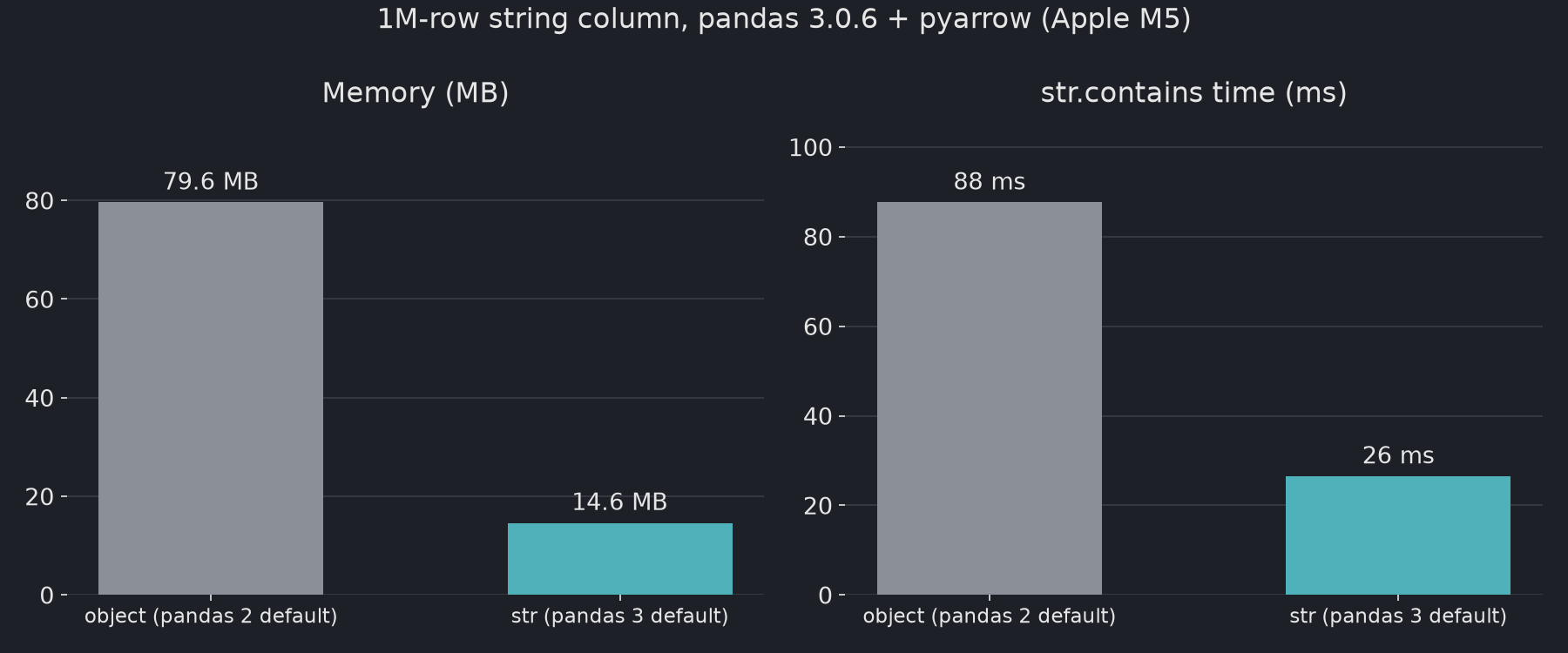
That is about 5× less memory and 3× faster str.contains on an Apple M5 (16 GB). Timings vary by about ±1 ms between runs. Without pyarrow installed, str falls back to object storage and you won’t see this gain.
Why are my timestamps 1000× smaller?
Parsed datetimes now default to microsecond resolution (datetime64[us]) instead of nanoseconds:
ts = pd.to_datetime(pd.Series(["2026-09-28 12:00"]))
print(ts.dtype, ts.astype("int64").iloc[0])
print(ts.dt.as_unit("ns").astype("int64").iloc[0])
2.3.3 -> datetime64[ns] 1790596800000000000
         1790596800000000000
3.0.6 -> datetime64[us] 1790596800000000
         1790596800000000000
If you store epoch integers or pass them to another system, call .dt.as_unit("ns") before casting.
Upgrade checklist
| Check | Search your code for | Fix |
|---|---|---|
| Chained assignment | df["x"][...] =, df[...]["x"] = | One .loc[rows, "x"] = |
| Relying on write-through | Editing a column Series or a slice | Assign back to df explicitly |
| String dtype checks | dtype == object, is None on strings | On 3.0: pd.api.types.is_string_dtype(s) and pd.isna(v) |
| Datetime to int | .astype("int64") on datetimes | .dt.as_unit("ns") first |
| Python version | Python 3.10 or older | pandas 3.0 needs Python 3.11+ |
Note that is_string_dtype returned False on 2.3.3 for the object Series above (it contains None), and True on 3.0.6. Don’t use it as a version-independent check.
The safest path is the one the pandas team recommends: move to 2.3, fix every warning, then move to 3.0.
Sources
- What’s new in 3.0.0 (January 21, 2026) — pandas docs, checked 2026-09-28
- Migration guide for the new string data type — pandas docs, checked 2026-09-28
- Copy-on-Write (CoW) — pandas docs, checked 2026-09-28
- pandas 3.0.6 on PyPI — released 2026-09-17